
Over the past two decades, the global economy has undergone a profound transformation. Businesses are no longer confined to national boundaries, financial regulations are becoming more complex, and technology is reshaping the way companies manage risk, compliance, and strategic decision-making.
In this new world,finance professionals are not just accountants—they are strategic interpreters of the global economy.And this is precisely whyglobally recognized qualifications like ACCA are emerging as powerful career pathways for the next generation.
From my perspective working closely with students, institutions, and industry throughEFOS, one thing is becoming increasingly clear:
The future workforce will be defined not just by degrees, but byglobally portable professional capabilities.
Finance careers like ACCA represent exactly that shift.
One of the most significant trends shaping the future of accounting and finance careers is theglobal shortage of qualified professionals.
Several studies highlight that the accounting profession is facing a serious talent pipeline challenge.
The world is entering a phase wherequalified finance professionals are becoming scarce but critically important.
This shortage is not temporary—it is structural.
A combination of factors is driving it:
For young professionals entering the workforce today, this represents ahistoric opportunity.
Another powerful trend reshaping finance careers is thegeographical shift of global finance operations.
International accounting firms and multinational companies are increasingly buildingglobal finance hubs in Indiato tap into skilled talent.
Recent developments show that many global accounting firms are expanding operations in India to address talent shortages in Western markets.
This trend mirrors what happened in the IT sector in the 1990s.
Just as India became theglobal technology back office, it is now emerging as aglobal finance and accounting talent hub.
Today:
This means thatIndian students with globally recognized finance qualifications can now work on international financial systems without even leaving the country.
Historically, accounting was seen as a compliance-driven profession focused on bookkeeping and audits.
That perception is outdated.
The modern finance professional operates at the intersection ofdata, strategy, technology, and governance.
Today’s accountants work in areas such as:
Industry insights show that ACCA-trained professionals are increasingly moving intohybrid roles like finance business partnering, enterprise risk analysis, and digital finance transformation.
In other words:
The accountant of the future is not a number cruncher — but astrategic interpreter of financial intelligence.
Recent surveys of finance professionals reveal dramatic shifts in career aspirations and job structures.
TheACCA Global Talent Trends Survey, which gathered responses fromover 10,000 professionals across 175 countries, provides some powerful insights.
These findings signal something important:
The finance profession is evolving into aflexible, global, and opportunity-rich career ecosystem.
The next decade will witness the rise of several specialized finance roles that align closely with ACCA competencies.
As businesses become data-driven, finance professionals will increasingly play roles indecision-making, risk management, and corporate strategy.
Finance careers like ACCA also offer strong salary growth globally.
Recruitment data shows that ACCA professionals are increasingly recruited in:
In India, ACCA professionals typically start with salaries around₹5–7 LPA and can grow significantly with experience, particularly in multinational finance roles.
Countries such as theUAE, UK, Canada, and Australiaoffer even higher salary trajectories as experience grows.
The global portability of the qualification is one of its strongest advantages.
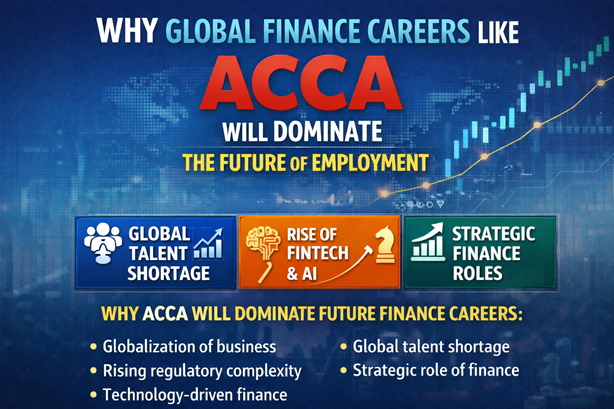
From a strategic perspective, five structural trends are driving the growth of global finance careers like ACCA.
Companies operate across multiple jurisdictions requiring global accounting expertise.
Governments and investors demand transparency, governance, and compliance.
AI, blockchain, and analytics are reshaping financial reporting.
There are fewer qualified accountants entering the profession globally.
Finance professionals now influence corporate strategy and business growth.
These trends ensure that globally trained finance professionals will remaincentral to the functioning of modern organizations.
For students planning their careers today, the key question is not:
“Which degree should I pursue?”
The more important question is:
“Which capability will remain relevant in a global economy?”
Finance qualifications like ACCA representportable, globally relevant professional capability.
At the same time, institutions must rethink how they prepare students.
Education cannot remain disconnected from industry realities.
Curriculum must align with:
This is precisely the gap that initiatives likeEFOS aim to bridge—connecting education with real industry pathways.
The workforce of the future will be defined bymobility, skills, and adaptability.
Careers like ACCA embody these characteristics.
They combine:
For the next generation of professionals, the message is clear:
The future will not belong to those who simply earn degrees. It will belong to those who buildglobally relevant professional capabilities.
And in the world of finance,ACCA is one of the most powerful pathways to that future.