In today's rapidly evolving job market, academic knowledge alone is no longer sufficient to build a successful career. Employers increasingly seek candidates who possess practical skills, industry exposure, problem-solving abilities, and professional experience. Recognizing this need, the University Grants Commission (UGC), under the vision of the National Education Policy (NEP) 2020, has made internships an integral part of undergraduate education in India. (UGC)
Internships are no longer optional additions to a student's profile—they are becoming a critical component of graduation and employability.
Traditionally, students spent years learning theories, concepts, and academic frameworks inside classrooms. However, many graduates struggled when entering the workforce because they lacked practical exposure to real-world environments.
To bridge the gap between education and industry, UGC introduced internship and research internship guidelines that encourage experiential learning, industry engagement, innovation, and skill development. The objective is simple:
Learn in the classroom. Apply in the real world.
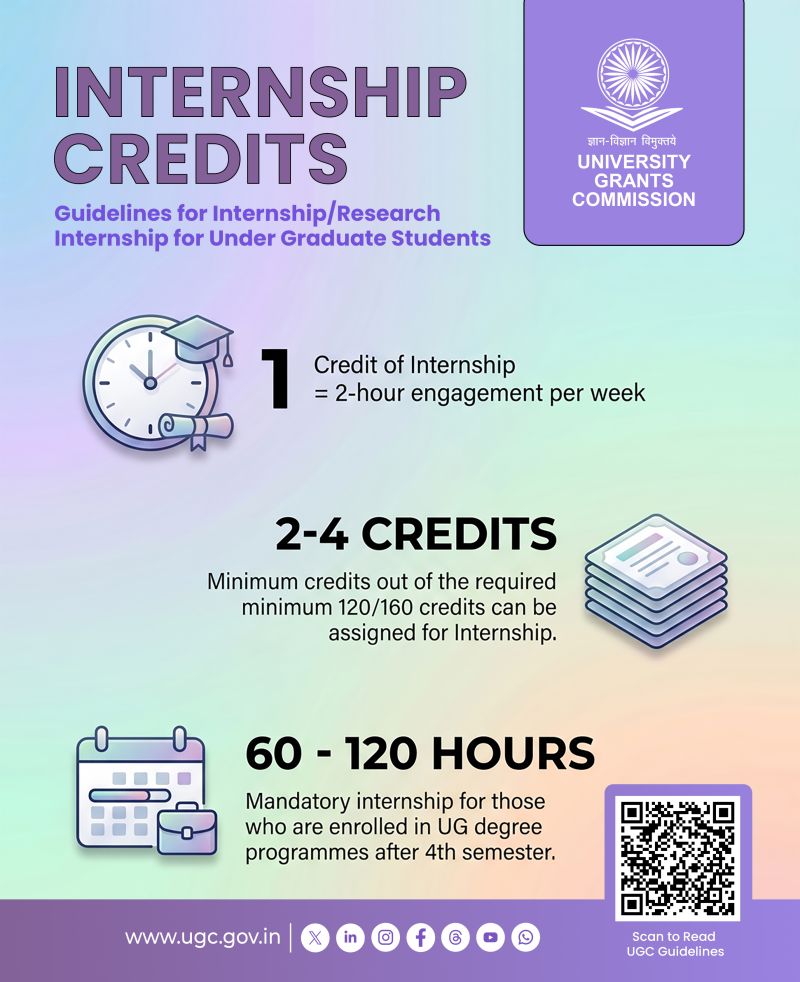
Under the UGC guidelines, undergraduate students are required to complete internships carrying academic credits as part of their degree programme. A minimum of 2–4 credits can be assigned to internships, and students are expected to complete internship engagements ranging from approximately 60–120 hours depending on the programme structure. (UGC)
An internship allows students to step outside textbooks and experience how organizations operate.
Students learn:
Professional communication
Team collaboration
Project management
Workplace ethics
Time management
These skills cannot be fully developed through classroom learning alone.
A Computer Science student may learn programming languages in college, but an internship provides opportunities to:
Build real applications
Work on live projects
Solve industry problems
Use professional tools
Similarly, students from business, commerce, arts, management, healthcare, and other disciplines gain practical understanding of their respective industries.
One of the biggest challenges graduates face is:
"You need experience to get a job, but you need a job to gain experience."
Internships solve this problem.
Students who complete internships have:
Stronger resumes
Better LinkedIn profiles
Practical project experience
Industry exposure
This significantly improves their chances of getting shortlisted for jobs and higher studies.
Technology and industries evolve faster than academic syllabi.
Internships help students learn:
Digital tools
AI tools
Industry software
Communication skills
Professional workflows
These skills often become deciding factors during recruitment.
Internships provide opportunities to connect with:
Industry professionals
Mentors
Recruiters
Team leaders
Entrepreneurs
Professional networking often leads to future opportunities, referrals, and career guidance.
Many students are unsure about their career direction.
An internship helps students discover:
What they enjoy doing
Which industries interest them
What skills they need to develop
Whether a particular career path suits them
This clarity is extremely valuable before graduation.
Employers prefer candidates who can demonstrate practical experience.
An internship helps students add:
Experience
Projects
Achievements
Certifications
Skills
to their resumes and LinkedIn profiles.
This immediately differentiates them from candidates who only possess academic qualifications.
According to UGC's Internship and Research Internship Guidelines:
Internships can carry 2–4 academic credits.
One internship credit generally corresponds to a defined engagement period.
Undergraduate students are expected to complete internships after the fourth semester.
Internship duration may range from approximately 60–120 hours depending on the programme and institution. (UGC)
The purpose is not merely to complete a requirement but to develop practical competencies alongside academic learning.
Many students wait until their final year to think about internships.
This is a mistake.
Students who begin internships early:
Build stronger portfolios
Gain confidence
Learn professional tools
Understand workplace expectations
Become more competitive during placements
By graduation, they already possess practical experience that employers value.
The EFOS Multi-Domain Internship Program is designed specifically to help students gain practical industry exposure while developing in-demand skills.
✅ Industry-Oriented Learning
✅ Practical Assignments and Projects
✅ AI Tools and Automation Training
✅ Resume Building and LinkedIn Optimization
✅ Portfolio Development
✅ Mentorship and Career Guidance
✅ Internship Certificate
✅ Professional Skill Development
The EFOS Internship Program is aligned with experiential learning objectives and offers 3 internship credits, helping students fulfill internship requirements while simultaneously building career-ready skills.
Students gain practical exposure in domains such as:
Artificial Intelligence
Data Analytics
Web Development
Full-Stack Development
Career Counselling
Human Resources
Business Development
Digital Marketing
Operations and Management
Internships are no longer optional learning experiences—they are an essential part of modern higher education.
UGC's internship framework recognizes that true learning happens when academic knowledge meets practical application. By participating in internships, students develop industry skills, gain professional experience, strengthen their employability, and prepare themselves for successful careers.
For students looking to gain meaningful industry exposure while earning academic internship credits, the EFOS Multi-Domain Internship Program provides an excellent opportunity to learn, build skills, work on projects, and advance their career journey.
Invest in your future today. Learn beyond the classroom. Gain experience before graduation. 🚀