A recent NDTV report highlighted a startling prediction: India may face a shortage of plumbers, electricians, carpenters, drivers, nurses, and caregivers within the next five years as developed countries increasingly recruit skilled workers from India.
For many people, this sounds surprising. India is often described as the world's youngest country with millions of young people entering the workforce every year. How can a nation with such a large population face a shortage of workers?
At EFOS, we believe the answer is simple:
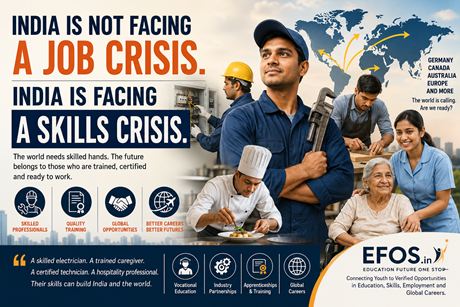
India is not facing a job crisis. India is facing a skills crisis.
For decades, our education system encouraged students to pursue traditional academic degrees while vocational skills were often viewed as a second-choice option.
The result is visible everywhere:
Thousands of engineering graduates struggling to find suitable employment.
Employers searching for skilled electricians, welders, technicians, plumbers, caregivers, and hospitality professionals.
Industries investing heavily in retraining fresh graduates.
Countries such as Germany, Canada, Australia, Japan, and many European nations actively recruiting skilled workers from India.
The global economy is sending a clear message:
Skills are becoming more valuable than degrees alone.
A plumber, electrician, HVAC technician, healthcare assistant, machine operator, caregiver, hotel professional, or logistics specialist today is no longer just a "blue-collar worker."
These professionals are:
Technically trained
Industry certified
Internationally employable
Increasingly well-paid
Less vulnerable to automation
While Artificial Intelligence is expected to impact many white-collar roles, skilled trades continue to experience strong demand worldwide. Recent discussions on the future of work have highlighted how many practical skill-based professions remain difficult to replace through automation.
One of the strongest examples comes from Germany.
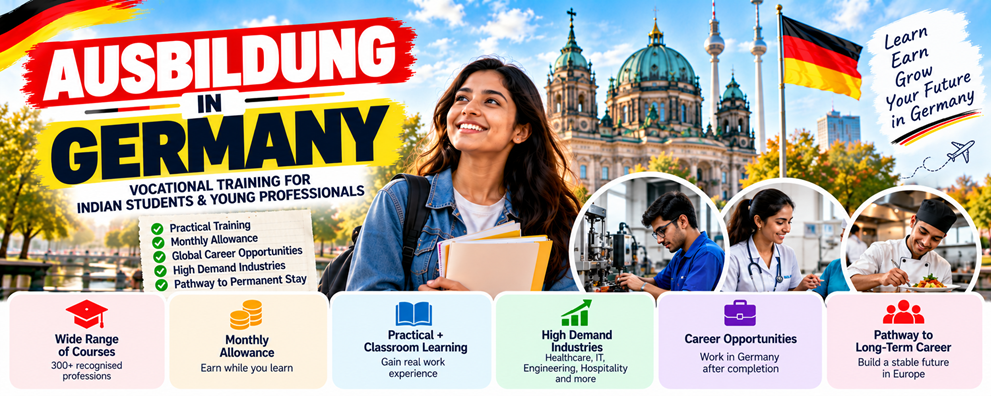
Through the Ausbildung system, students learn while they work, receive practical training, earn a stipend, and build careers in sectors such as:
Healthcare
Childcare
Hospitality
Logistics
Mechatronics
Electrical Systems
Manufacturing
Many of these professions offer stronger long-term employability than conventional degree pathways.
At EFOS, we are witnessing growing interest among Indian youth in international skill-based careers, especially in Germany, where trained professionals are urgently required due to demographic changes and workforce shortages.
India has a unique opportunity.
The world is ageing.
India is young.
The world needs skilled workers.
India has the potential to become the largest supplier of trained talent globally.
However, this opportunity can only be realized if we:
Skill-based careers should be seen as professional career pathways, not fallback options.
Students should learn through apprenticeships, internships, and work-integrated education models.
Language training, international certifications, and overseas workforce preparation should become mainstream.
Every course should answer one simple question:
"What job or career opportunity will this create?"
At EFOS, we have always believed that education must lead to employability.
Our work with universities, training providers, employers, and international partners is focused on one goal:
Connecting youth to verified education, skill development, apprenticeships, and employment opportunities.
Whether it is:
Hotel Management under Learn-and-Earn models,
German Language and Ausbildung pathways,
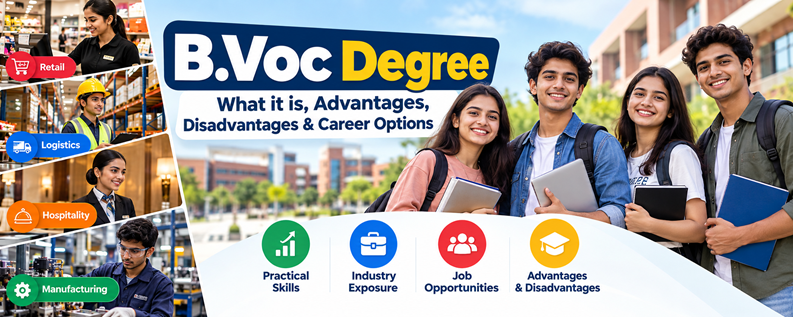
Vocational diplomas,
Apprenticeships,
Healthcare support careers,
Logistics and manufacturing skills,
the objective remains the same:
Make young people employable, confident, and future-ready.
The debate is no longer "degree versus skill."
The future belongs to individuals who combine:
Knowledge
Practical skills
Digital literacy
Communication ability
Industry experience
A skilled electrician with international certification may have better career prospects than an unemployed graduate.
A trained caregiver may find opportunities across multiple countries.
A hospitality professional may build a global career.
A technician may become an entrepreneur.
The next decade will reward competence, adaptability, and employable skills.
India's youth must prepare accordingly.
EFOS – Education Future One Stop
Connecting Youth to Verified Opportunities in Education, Skills, Employment, Apprenticeships and Global Careers.