The IT industry is one of the fastest-growing fields in the world, offering exciting roles, high salaries, and global opportunities. Whether you love coding, design, problem-solving, or managing people, there is a place for you in IT.
In this guide, you’ll learn about the top IT careers, what skills you need, popular courses, and average salary ranges so you can plan your future with confidence.
Why Choose a Career in IT?
- High demand for skilled professionals.
- Good starting salaries and strong growth.
- Opportunities to work remotely or abroad.
- Flexible roles: technical, creative, analytical, or managerial.
- Continuous learning and innovation.
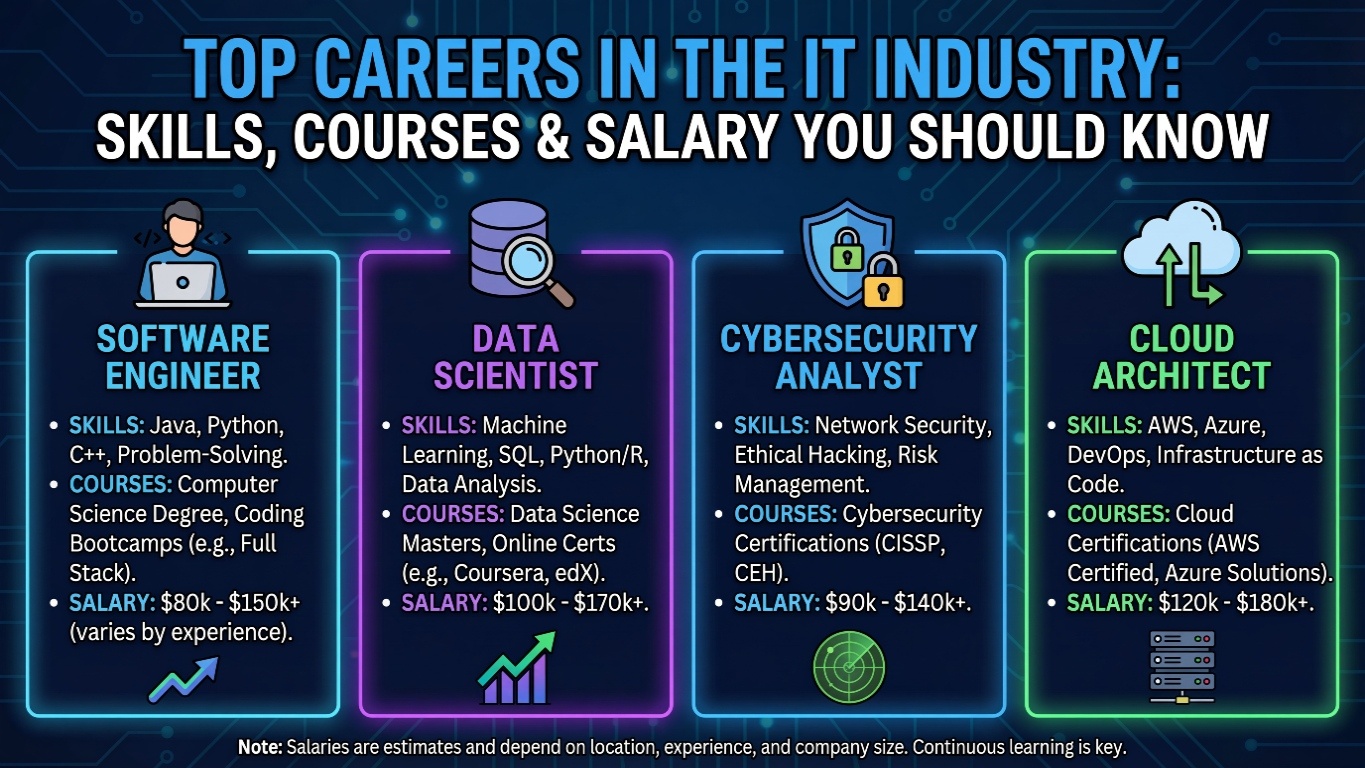
1. Software Developer / Software Engineer
Software developers build applications, websites, and software systems used in every industry—from banking apps to social media platforms.
What does a Software Developer do?
- Writes and tests code for applications and systems.
- Fixes bugs and improves performance.
- Works with teams (designers, testers, product managers).
- Builds mobile apps, web apps, desktop software, or backend systems.
Essential skills
- Programming languages:
- Web: HTML, CSS, JavaScript
- General: Java, Python, C++, C#
- Version control: Git, GitHub or GitLab
- Problem-solving and logic
- Basic data structures and algorithms
- Understanding of databases (SQL, MySQL, PostgreSQL, MongoDB)
Recommended courses and degrees
- Degrees:
- B.Tech / B.E. in Computer Science / IT
- B.Sc in Computer Science
- Online courses:
- “Introduction to Computer Science” (Harvard CS50 – edX)
- “Java Programming” / “Python for Everybody” (Coursera)
- Web development bootcamps (Udemy, freeCodeCamp)
Average salary range (India)
- Entry-level: ₹3 LPA – ₹6 LPA
- Mid-level (3–6 years): ₹8 LPA – ₹18 LPA
- Senior (7+ years): ₹18 LPA – ₹35 LPA+
(Abroad, starting salaries are often 40,00040,000–80,00080,000 USD per year depending on country.)
2. Web Developer (Front-End, Back-End, Full-Stack)
Web developers specialize in building websites and web applications.
Types of Web Developers
- Front-end developer: Works on the part users see (design, layout, buttons, animations).
- Back-end developer: Works on server, database, and application logic.
- Full-stack developer: Handles both front-end and back-end.
Essential skills
- Front-end:
- HTML, CSS, JavaScript
- Frameworks: React, Angular, Vue
- Responsive design, basic UI/UX understanding
- Back-end:
- Node.js, Java, Python (Django/Flask), PHP, .NET
- Databases: MySQL, PostgreSQL, MongoDB
- APIs, authentication, security basics
Recommended courses
- “Responsive Web Design” – freeCodeCamp
- “The Complete Web Developer Bootcamp” – Udemy
- Specialized courses on React, Node.js, or Django
Average salary range (India)
- Entry-level: ₹3 LPA – ₹5 LPA
- Mid-level: ₹6 LPA – ₹15 LPA
- Senior/full-stack: ₹15 LPA – ₹30 LPA+
3. Data Scientist
Data scientists use data to help companies make smarter decisions. This is one of the most in-demand and high-paying roles in IT.
What does a Data Scientist do?
- Collects, cleans, and analyzes large datasets.
- Builds predictive models using machine learning.
- Visualizes data to find patterns and insights.
- Works with business teams to solve real-world problems.
Essential skills
- Programming: Python or R
- Libraries: NumPy, Pandas, Scikit-learn, Matplotlib, Seaborn
- Statistics and probability
- Machine learning basics
- SQL for working with databases
- Data visualization tools: Power BI, Tableau
Recommended courses and degrees
- Degrees:
- B.Tech in Computer Science with Data Science / AI
- B.Sc in Statistics / Mathematics / Computer Science
- M.Sc in Data Science / Analytics
- Online courses:
- “IBM Data Science Professional Certificate” – Coursera
- “Machine Learning” by Andrew Ng – Coursera
- “Data Analyst/Scientist” career tracks – DataCamp
Average salary range (India)
- Entry-level: ₹6 LPA – ₹12 LPA
- Mid-level: ₹12 LPA – ₹25 LPA
- Senior: ₹25 LPA – ₹50 LPA+
4. Data Analyst
Data analysts focus more on interpreting data and generating reports rather than building complex models.
What does a Data Analyst do?
- Cleans and organizes data.
- Creates dashboards and reports.
- Helps teams understand trends and performance.
- Answers business questions using data.
Essential skills
- Excel (advanced functions, pivot tables, charts)
- SQL
- BI tools: Power BI, Tableau, Google Data Studio
- Basic statistics
- Python or R (optional but useful)
Recommended courses
- “Google Data Analytics Professional Certificate” – Coursera
- “Excel to MySQL: Analytic Techniques” – Coursera
- Power BI / Tableau beginner to advanced courses – Udemy
Average salary range (India)
- Entry-level: ₹3 LPA – ₹6 LPA
- Mid-level: ₹6 LPA – ₹12 LPA
- Senior: ₹12 LPA – ₹20 LPA+
5. Artificial Intelligence (AI) & Machine Learning Engineer
AI/ML engineers build systems that can learn from data and make decisions—like recommendation engines, chatbots, or image recognition systems.
What does an AI/ML Engineer do?
- Designs and trains machine learning models.
- Works with large datasets.
- Implements AI features in products (e.g., search, recommendations).
- Optimizes models for performance and accuracy.
Essential skills
- Strong Python programming
- Machine learning algorithms (classification, regression, clustering)
- Deep learning: Neural networks, CNNs, RNNs (TensorFlow, Keras, PyTorch)
- Mathematics: Linear algebra, calculus, probability
- Data handling: Pandas, NumPy, SQL
Recommended courses and degrees
- Degrees:
- B.Tech in Computer Science with AI/ML specialization
- M.Tech / M.Sc in AI, ML, Data Science
- Online courses:
- “Machine Learning” – Andrew Ng (Coursera)
- “Deep Learning Specialization” – Coursera
- “AI Programming with Python” – Udacity
Average salary range (India)
- Entry-level: ₹6 LPA – ₹12 LPA
- Mid-level: ₹12 LPA – ₹30 LPA
- Senior: ₹30 LPA – ₹60 LPA+
6. Cybersecurity Specialist / Ethical Hacker
Cybersecurity specialists protect systems and data from attacks. Ethical hackers test security by trying to break into systems legally.
What does a Cybersecurity Specialist do?
- Monitors networks for suspicious activities.
- Secures systems using firewalls, encryption, and security tools.
- Performs vulnerability assessments and penetration tests.
- Responds to security breaches and incidents.
Essential skills
- Networking basics (TCP/IP, DNS, routers, firewalls)
- Operating systems: Windows, Linux
- Security concepts: encryption, authentication, access control
- Tools: Wireshark, Nmap, Metasploit, Burp Suite
- Scripting: Python, Bash (optional but useful)
Recommended courses and certifications
- Degrees:
- B.Tech in Cybersecurity / Computer Science
- Certifications (very important in this field):
- CompTIA Security+
- CEH (Certified Ethical Hacker)
- CISSP (for advanced professionals)
- Online courses:
- “Cybersecurity Specialization” – Coursera
- “Ethical Hacking” – Udemy
Average salary range (India)
- Entry-level: ₹4 LPA – ₹8 LPA
- Mid-level: ₹8 LPA – ₹20 LPA
- Senior: ₹20 LPA – ₹40 LPA+
7. Cloud Engineer / Cloud Architect
Cloud professionals manage applications and data on platforms like AWS, Azure, and Google Cloud.
What does a Cloud Engineer do?
- Sets up and manages cloud servers, databases, and services.
- Ensures applications are scalable, secure, and cost-effective.
- Works with DevOps teams to automate deployments.
Essential skills
- Cloud platforms: AWS, Microsoft Azure, Google Cloud Platform (GCP)
- Linux and networking basics
- Containers and orchestration: Docker, Kubernetes
- Infrastructure as Code (IaC): Terraform, AWS CloudFormation
- Scripting: Python, Bash
Recommended courses and certifications
- AWS Certified Cloud Practitioner / Solutions Architect
- Microsoft Certified: Azure Fundamentals / Administrator
- Google Cloud Associate Engineer
- Cloud engineer paths on Coursera, Udemy, or A Cloud Guru
Average salary range (India)
- Entry-level: ₹5 LPA – ₹9 LPA
- Mid-level: ₹9 LPA – ₹22 LPA
- Senior/architect: ₹22 LPA – ₹45 LPA+
8. DevOps Engineer
DevOps engineers bridge the gap between development and operations. They automate and streamline the software development lifecycle.
What does a DevOps Engineer do?
- Automates code building, testing, and deployment (CI/CD).
- Manages servers and cloud environments.
- Monitors system performance and uptime.
- Works closely with developers and IT operations teams.
Essential skills
- Linux and networking
- CI/CD tools: Jenkins, GitHub Actions, GitLab CI
- Containers: Docker, Kubernetes
- Cloud knowledge (AWS, Azure, GCP)
- Scripting: Bash, Python
- Tools: Ansible, Terraform, Prometheus, Grafana
Recommended courses
- “DevOps Engineer” paths – Udacity, Coursera
- Docker, Kubernetes, Jenkins courses – Udemy
- Cloud DevOps Engineer nanodegree – Udacity
Average salary range (India)
- Entry-level: ₹5 LPA – ₹10 LPA
- Mid-level: ₹10 LPA – ₹25 LPA
- Senior: ₹25 LPA – ₹45 LPA+
9. UI/UX Designer
If you are creative and like design, UI/UX might be perfect for you. It’s about making digital products easy, attractive, and enjoyable to use.
What does a UI/UX Designer do?
- Researches user needs and behavior.
- Designs app and website layouts, flows, and interactions.
- Creates wireframes, prototypes, and visual designs.
- Works closely with developers and product managers.
Essential skills
- Design tools: Figma, Adobe XD, Sketch
- Basic design principles: color, typography, layout
- User research and usability testing
- Wireframing and prototyping
- Basic understanding of HTML/CSS (optional but helpful)
Recommended courses
- “Google UX Design Professional Certificate” – Coursera
- UI/UX design bootcamps – Udemy, Interaction Design Foundation
- Figma-focused tutorials (YouTube, free courses)
Average salary range (India)
- Entry-level: ₹3 LPA – ₹6 LPA
- Mid-level: ₹6 LPA – ₹15 LPA
- Senior: ₹15 LPA – ₹30 LPA+
10. IT Support Engineer / System Administrator
This is a great entry point into IT for many students. IT support professionals solve technical problems for users and maintain systems.
What does an IT Support Engineer do?
- Installs and configures software and hardware.
- Troubleshoots network, system, and device issues.
- Supports employees or customers with technical problems.
- Maintains servers, backups, and basic security.
Essential skills
- Operating systems: Windows, Linux basics
- Networking fundamentals: IP, DNS, routers, switches
- Hardware basics: PCs, printers, peripherals
- Communication and customer support skills
- Basic scripting (optional)
Recommended courses and certifications
- CompTIA A+ (entry-level IT support)
- CompTIA Network+ (network fundamentals)
- Google IT Support Professional Certificate – Coursera
Average salary range (India)
- Entry-level: ₹2.5 LPA – ₹4.5 LPA
- Mid-level: ₹4.5 LPA – ₹8 LPA
- Senior / System admin: ₹8 LPA – ₹15 LPA+
11. Business Analyst (IT)
Business analysts act as a bridge between business and tech teams.
What does a Business Analyst do?
- Understands business needs and problems.
- Collects and documents requirements.
- Works with developers and testers to build the right solutions.
- Analyzes processes and suggests improvements.
Essential skills
- Strong communication and presentation skills
- Basic understanding of software development lifecycle (SDLC)
- Tools: Excel, PowerPoint, Jira, Confluence
- Basic SQL and data analysis
- Domain knowledge (finance, e-commerce, healthcare, etc.)
Recommended courses
- Business analysis foundations – LinkedIn Learning
- CBAP / CCBA exam prep (for advanced professionals)
- “Google Business Intelligence Professional Certificate” – Coursera
Average salary range (India)
- Entry-level: ₹4 LPA – ₹7 LPA
- Mid-level: ₹7 LPA – ₹15 LPA
- Senior: ₹15 LPA – ₹30 LPA+
How to Choose the Right IT Career for You
Choosing a career can feel overwhelming, but you can make it easier by asking yourself a few questions.
1. What do you enjoy?
- Enjoy coding and logic? → Software developer, web developer, AI/ML engineer.
- Like numbers and patterns? → Data scientist, data analyst.
- Love problem-solving and security? → Cybersecurity specialist.
- Creative and design-focused? → UI/UX designer.
- Good at communication and coordination? → Business analyst, project manager (later).
2. What is your current skill level?
- Beginner: Start with basics—programming (Python/Java), web development, or IT support.
- Intermediate: Explore specialization—data science, cybersecurity, cloud, DevOps.
3. What kind of lifestyle do you want?
- Remote work and flexible hours: Software, data, cloud, and UI/UX roles often support this.
- High responsibility and leadership (later): DevOps, cloud architect, product manager, engineering manager.
Essential Skills for All IT Careers
No matter which IT role you choose, these skills will always help you:
- Problem-solving mindset
- Logical thinking
- Basic programming (Python or Java)
- Good communication (written and verbal)
- Teamwork and collaboration
- Willingness to learn continuously
Tips for Students to Get Started
- Learn the basics: Start with one language (Python/JavaScript) and build small projects.
- Build a portfolio: Put your work on GitHub, Behance (for designers), or personal websites.
- Do internships and freelance projects: Gain real-world experience early.
- Network: Join LinkedIn, attend webinars, hackathons, and meetups.
- Get certifications: Especially useful in fields like cloud, cybersecurity, and data.
Final Thoughts
The IT industry offers countless opportunities for students from different backgrounds. You don’t have to know everything today—what matters is starting, learning step by step, and building real skills.
Pick a career path that matches your interests, learn the core skills, take relevant courses, and gradually build experience through projects and internships. Your IT career can then grow in the direction you choose—technical expert, manager, entrepreneur, or researcher.