For many people, getting a job means putting higher education on hold. Financial responsibilities, family commitments, work schedules, relocation and lack of time can make it difficult to attend a regular college.
But today, work and higher education do not always have to be an either-or decision.
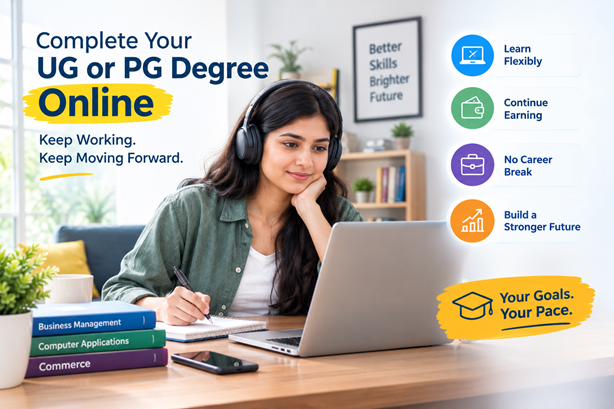
Online degree programmes can allow eligible students and working professionals to pursue an Undergraduate (UG) or Postgraduate (PG) degree while continuing their jobs.
If you had to stop your education, started working after Class 12 or want to pursue a postgraduate qualification without taking a career break, an appropriately recognised online programme may be worth considering.
An online degree is a higher-education programme delivered primarily through digital learning platforms. Depending on the university and programme, students may access recorded or live classes, digital study materials, assignments, academic support and examinations through approved modes.
Popular UG and PG programmes offered online may include areas such as:
BBA
B.Com
BA
BCA
MBA
M.Com
MA
MCA
Programme availability, eligibility and recognition can differ by university and academic session. Students should always verify the institution and specific programme before enrolling.
One of the biggest challenges of returning to college is the possibility of losing regular income.
For someone already employed, leaving a job for full-time education may not be practical.
Online learning can provide greater flexibility, allowing many working learners to continue earning while pursuing higher education.
This can be especially useful for people supporting themselves or their families.
A traditional full-time programme can require students to attend classes according to a fixed schedule.
For working professionals, this could mean taking a career break.
With a suitable online programme, you may be able to continue gaining professional experience while progressing academically.
After a few years, instead of having only work experience or only an additional qualification, you could potentially have both professional experience and a higher qualification.
Working professionals rarely have the same schedule as full-time students.
Online programmes can offer greater flexibility in accessing lectures and learning materials. Depending on the programme, learners may be able to study before work, after office hours or during weekends.
However, online education should not be confused with effortless education. Students still need discipline, regular study, assignment completion and examination preparation.
Flexible does not mean easy—it means you have more control over when and where you learn.
Not everyone follows a straight path from school to college to employment.
Some people start working after Class 12. Others discontinue college because of financial difficulties, family responsibilities, relocation or personal circumstances.
For eligible candidates, an online UG programme may provide a pathway to restart higher education without necessarily giving up employment.
Similarly, graduates who started working immediately after their bachelor's degree can explore online PG programmes while continuing their careers.
A job teaches you through practical experience, while a degree can provide structured academic learning.
Combining the two can be valuable.
For example, someone working in sales while studying BBA may connect classroom concepts with real customer situations. A professional pursuing an MBA may be able to relate subjects such as marketing, finance, operations or human resources to workplace situations.
This combination can make learning more relevant because you can connect theory with real-world experience.
Your current job may not be the job you want five years from now.
Some future roles, employers, examinations or further-education programmes may have specific educational eligibility requirements.
Completing an appropriate UG or PG qualification can help you meet educational requirements for opportunities where that qualification is accepted.
However, a degree by itself does not guarantee a promotion, salary increase or job. Career growth also depends on factors such as your skills, experience, performance, industry, employer and the requirements of a particular position.
Think of higher education as one part of your long-term career development—not a guaranteed shortcut to success.
Studying while working can also help develop useful professional habits.
Managing both responsibilities may strengthen:
Time management
Self-discipline
Digital learning skills
Communication
Problem-solving
Independent learning
Planning and prioritisation
These abilities can be valuable in the workplace as well as in academics.
Online UG or PG education may be worth exploring if you:
Are already working and do not want to leave your job
Started working after Class 12 and want to pursue graduation
Have completed graduation and want to pursue a postgraduate qualification
Need greater flexibility because of work or family responsibilities
Live far from the institution where you want to study
Want to combine professional experi