
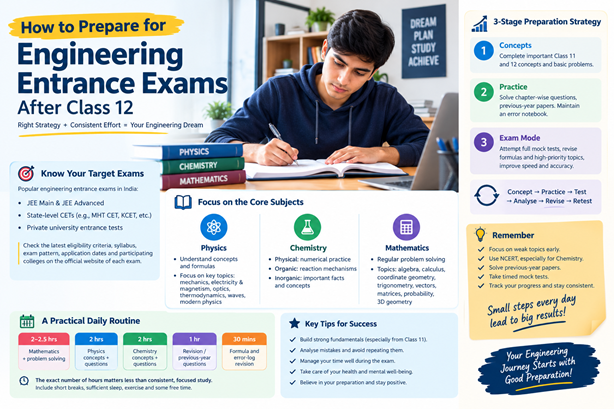
For a Class 12 pass candidate preparing for engineering entrance exams in India—such as JEE Main, JEE Advanced, state-level CETs, and private university entrance tests—the preparation should focus on Physics, Chemistry, Mathematics, exam practice, and a realistic study routine.
1. Choose your target exams first. Make a list of the engineering entrance exams you want to attempt. Check each exam’s current eligibility criteria, syllabus, pattern, application dates, and participating colleges on the official website. Different exams can have different requirements.
2. Strengthen Class 11 and 12 fundamentals. Most engineering entrance preparation is based on concepts studied in Classes 11 and 12. Start by identifying weak chapters rather than immediately attempting difficult questions. NCERT textbooks are particularly useful for building fundamentals, especially in Chemistry.
3. Prepare Physics conceptually. Understand the concept and formulas before solving questions. Focus on areas such as mechanics, electricity and magnetism, optics, thermodynamics, waves, and modern physics. Maintain a short formula and concept notebook for revision.
4. Give Mathematics daily practice. Mathematics improves through regular problem-solving. Topics such as algebra, calculus, coordinate geometry, trigonometry, vectors, matrices, probability, and 3D geometry deserve systematic practice. Analyse incorrect answers instead of simply solving more questions.
5. Make Chemistry scoring. Divide Chemistry into Physical, Organic, and Inorganic Chemistry. Practise numerical problems for Physical Chemistry, understand reaction mechanisms in Organic Chemistry, and revise important facts and concepts regularly for Inorganic Chemistry.
6. Use previous-year papers. Once you have covered the fundamentals of a chapter, solve previous-year questions from your target examination. This helps you understand the actual difficulty, recurring concepts, question style, and speed required.
7. Take timed mock tests. Full-length mock tests become increasingly important as the exam approaches. Reproduce real examination conditions as closely as possible. After every test, classify your mistakes into conceptual errors, calculation errors, forgotten formulas, poor question selection, and time-management problems.
A student studying full-time after Class 12 could begin with a routine such as:
| Time | Preparation |
|---|---|
| 2–2.5 hours | Mathematics + problem solving |
| 2 hours | Physics concepts + questions |
| 2 hours | Chemistry concepts + questions |
| 1 hour | Revision / previous-year questions |
| 30 minutes | Formula and error-log revision |
The exact number of hours matters less than consistent, focused study and measurable improvement. Include short breaks, sufficient sleep, exercise, and some free time rather than creating an unsustainable 12–14-hour schedule.
Stage 1 – Concepts: Complete important Class 11 and 12 concepts and basic problems.
Stage 2 – Practice: Move to chapter-wise entrance-level questions and previous-year papers. Keep an error notebook and revisit weak topics.
Stage 3 – Exam Mode: Attempt full mock tests, revise formulas and high-priority concepts, improve speed and accuracy, and avoid starting too many new resources near the examination.
A useful rule is Concept → Practice → Test → Analyse → Revise → Retest.
For a Class 12 pass candidate taking a drop year, the biggest advantage is having fewer school-board commitments. Use that time to repair Class 11 weaknesses early rather than spending the entire year only revising Class 12 topics.