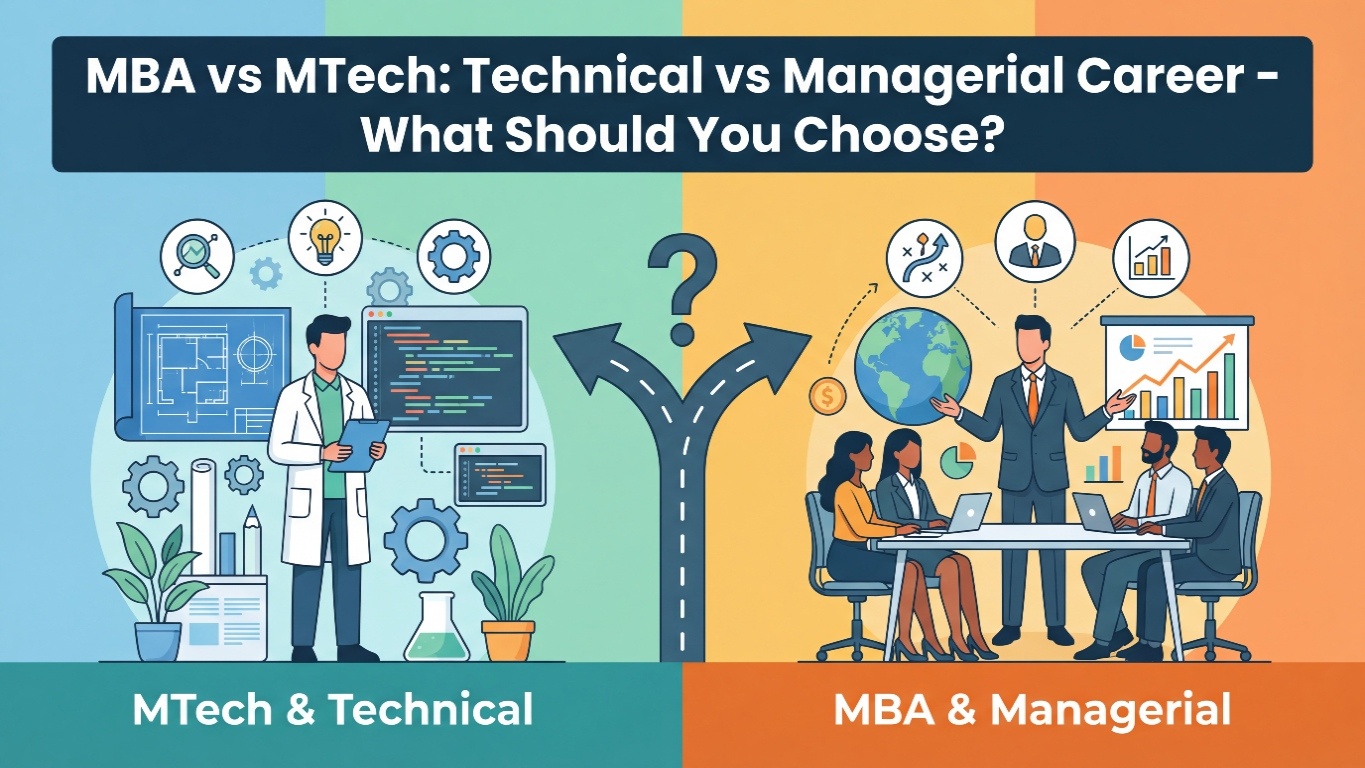
In today's fast-evolving job market, choosing between an MBA (Master of Business Administration) and an MTech (Master of Technology) can feel like standing at a career crossroads. With India's tech boom and booming management sectors—like IT, consulting, fintech, and even hospitality—both degrees promise high salaries, growth, and prestige. But which path aligns with your skills, interests, and long-term goals?
If you're an engineering graduate from Greater Noida or elsewhere in Uttar Pradesh, torn between diving deeper into tech innovation or shifting to leadership roles, this guide breaks it down. We'll compare MBA vs MTech across key factors: curriculum, career prospects, salaries, ROI, and real-world fit. By the end, you'll have a clear framework to decide—technical depth or managerial breadth?
An MBA equips you for managerial roles, focusing on business strategy, leadership, finance, marketing, and operations. It's ideal for those who love people management, decision-making, and scaling businesses. Top programs like IIMs or XLRI emphasize case studies, internships, and networking.
On the flip side, MTech builds on your BTech foundation with advanced technical skills in areas like AI, cybersecurity, data science, or VLSI design. Offered by IITs, NITs, or private institutes like VIT, it suits problem-solvers who thrive on coding, R&D, and innovation.
| Aspect | MBA | MTech |
|---|---|---|
| Focus | Business acumen, leadership | Technical expertise, research |
| Duration | 1-2 years (full-time) | 2 years |
| Eligibility | Any bachelor's + entrance (CAT, XAT) | BTech + GATE |
| Top Institutes | IIM Ahmedabad, ISB, FMS Delhi | IIT Bombay, IIT Delhi, IISc Bangalore |
Exams: CAT (99+ percentile for IIMs), XAT, GMAT.
Profile Boosters: 1-2 years work experience, strong academics (60%+), extracurriculars.
Fees: ₹15-25 lakhs (IIMs); scholarships available for merit/deserving candidates.
Trend 2026: Hybrid MBAs rising post-pandemic, with focus on fintech and sustainability.
Exams: GATE (top 1000 rank for IITs).
Profile: Strong BTech CGPA (7.5+), projects/research papers.
Fees: ₹2-5 lakhs (subsidized in IITs/NITs).
Trend 2026: PSUs and startups prioritizing GATE scorers for AI/ML roles.
Pro Tip: If you're from Uttar Pradesh, check state quotas in UPSEE or AKTU-affiliated colleges for easier entry.
MBA curricula blend theory with practice:
Core: Finance, Marketing, HR, Operations, Strategy.
Electives: Digital Marketing, Supply Chain (relevant for hotel management aspirants).
Skills Gained: Negotiation, analytics (via tools like Excel, Tableau), leadership.
MTech dives deep into tech:
Core: Advanced algorithms, machine learning, embedded systems.
Electives: IoT, Blockchain, Robotics.
Skills Gained: Coding (Python, MATLAB), simulations, thesis research.
Example: An MBA grad might manage a hotel chain's operations; an MTech grad could develop its smart booking AI.
Roles: Product Manager, Consultant (McKinsey, BCG), Marketing Head, Operations Manager.
Industries: Consulting, Banking, E-commerce (Amazon, Flipkart), Hospitality.
Growth: Fast-track to C-suite; 70% alumni in leadership roles within 5-10 years.
Roles: Software Engineer, Data Scientist, R&D Specialist, Tech Lead.
Industries: IT (TCS, Infosys), Semiconductors, EVs (Tata, Ola Electric).
Growth: Specialist to CTO; high demand in India's $1 trillion digital economy target by 2028.
Technical vs Managerial: MTech keeps you hands-on with tech stacks; MBA shifts you to stakeholder management and P&L responsibility.
Freshers earn well, but ROI varies by institute and experience.
| Parameter | MBA (Tier-1 like IIMs) | MTech (IITs) |
|---|---|---|
| Avg Fresher Salary | ₹25-35 LPA | ₹15-25 LPA |
| 5-Year Avg | ₹40-60 LPA | ₹30-50 LPA |
| ROI Timeline | 3-5 years | 2-4 years |
| Placement Rate | 95-100% | 90-95% |
Versatile careers, global mobility.
Networking goldmine (alumni networks).
Suits non-tech backgrounds.
Cons
High fees, competitive admissions.
Less technical depth if you're a coder at heart.
Lower costs, specialized skills.
Recession-proof in tech hubs like Bengaluru/Noida.
Direct PhD/research path.
Cons
Narrower job market if uninterested in pure tech.
Slower salary ramp-up without experience.
MBA: Sundar Pichai (IIT + Stanford MBA) – Google CEO, blending tech smarts with management.
MTech: Parag Agrawal (IIT Bombay MTech) – Ex-Twitter CTO, pure tech leadership.
Hotel Mgmt Angle: An MBA from IHM can pivot you to ops roles at Taj/Oberoi, while MTech aids tech integrations like app-based services.
Neither is "better"—it depends on technical vs managerial career alignment. Choose MTech for innovation and stability in engineering-heavy fields. Opt for MBA if you crave leadership, higher earnings, and business impact, especially in dynamic sectors like hotel management.