
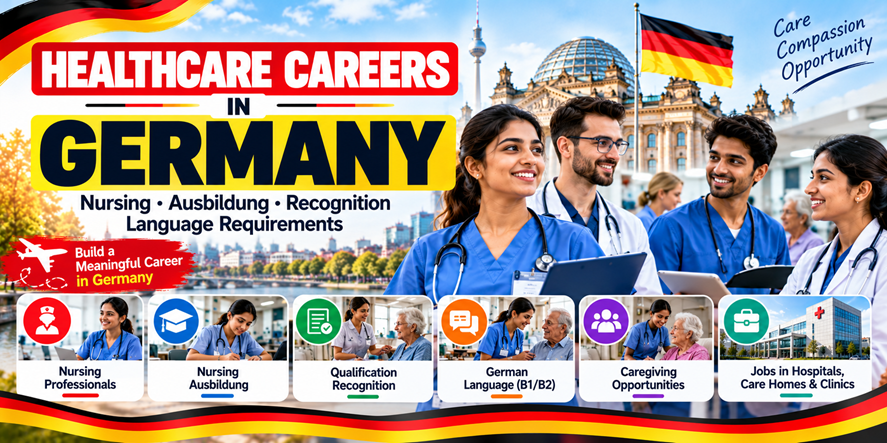
Career Guidance • Germany • Indian Students and Healthcare Professionals • 2026
Germany offers several healthcare career pathways, from nursing and elderly care to healthcare support and vocational training. For Indian applicants, the right route depends on whether you already hold a healthcare qualification or are planning to train for a new profession.
The most important distinction: a qualified nurse seeking recognition is following a different process from a student applying for nursing Ausbildung. Both routes require careful preparation, and neither guarantees a job or visa.
This guide explains the main pathways, German-language expectations, qualification recognition, application steps, and practical checks to make before committing to a programme.
Germany has an established healthcare system that includes hospitals, rehabilitation centres, nursing homes, outpatient services, and home-care providers. Nursing and care are important parts of this system, and the German government provides dedicated guidance for internationally qualified nursing professionals.
For Indian candidates, possible advantages include:
Structured vocational training routes in nursing.
Opportunities to apply existing healthcare qualifications for recognition.
Career development through additional training and specialisation.
Experience working in an international healthcare environment.
Potential long-term career progression, depending on qualifications, employment, and residence status.
However, demand varies by occupation and region. Applicants should research genuine vacancies and current requirements rather than rely on claims that every healthcare worker will automatically get a job.
Nursing professional — Pflegefachfrau / Pflegefachmann
A qualified nursing role involving patient care, clinical observation, care planning, and coordination with healthcare teams. Internationally qualified nurses generally need recognition of their qualifications and permission to use the professional title.
Nursing Ausbildung
A vocational training route for candidates who want to train as nursing professionals in Germany. It combines theoretical education with practical placements and generally takes three years in the full-time generalist programme.
Elderly care and support services
Roles can include supporting older people with daily activities and care needs. The training, qualification, and permitted duties vary by occupation and German state.
Other healthcare professions
Depending on your background, you might investigate medical laboratory work, physiotherapy, radiology-related professions, or other allied health occupations. Recognition and licensing rules differ across professions.
These pathways are not interchangeable. In particular, nursing is a regulated profession in Germany, meaning foreign-trained nurses must meet the applicable recognition and licensing requirements before practising as qualified nurses.
Ausbildung is an option for people who want to train for a profession rather than apply directly as an already-qualified nurse.
Germany's generalist nursing training prepares trainees to care for people across different age groups and care settings.
Classroom learning: Nursing knowledge, healthcare procedures, professional responsibilities, and related subjects.
Practical placements: Supervised learning in healthcare settings.
Professional communication: Communicating with patients, families, and medical teams.
Assessment: Completing the required training and examinations.
The programme generally lasts three years full-time. Trainees may have opportunities to specialise in the final part of training or continue with the generalist nursing qualification, depending on the applicable programme arrangements.
Applicants commonly need to check:
A school-leaving qualification that meets the training provider's requirements.
German-language proficiency, often B1 or B2 depending on the federal state and training provider.
Evidence of medical fitness.
Evidence of reliability or a criminal-record check.
A suitable training place and the necessary visa, if applying from India.
The exact academic requirements and accepted documents should be confirmed with the training institution.
Company-based nursing training generally includes a monthly training allowance. The amount varies according to the employer, training year, applicable agreements, and location.
Do not assume that the allowance will cover all expenses. Compare the actual offer with accommodation, food, transport, insurance, and other living costs before accepting a position.
For visa purposes, Germany's 2026 guidance generally considers the livelihood requirement met for company-based vocational training when the training allowance is at least €1,048 gross or €822 net per month. If the allowance is lower, additional financial proof may be required. These are visa livelihood thresholds, not guaranteed nursing salaries.
If you already hold a nursing qualification from India, investigate professional recognition before deciding to repeat your training.
Germany assesses foreign nursing qualifications against the corresponding German professional qualification. The competent authority examines the applicant's education and may identify differences between the foreign training and German requirements.
Identify the competent authority
The responsible authority depends on the German state where you intend to work.
Submit your qualification documents
You may need nursing certificates, transcripts, details of course content and clinical hours, proof of experience, identity documents, and certified translations where required.
Receive the assessment
The authority determines whether your qualification is equivalent or whether substantial differences need to be addressed.
Complete any required compensatory measures
If differences are identified, you may be required to complete an adaptation programme or a knowledge assessment, depending on the applicable procedure.
Meet the remaining licensing conditions
These can include German-language proficiency, medical fitness, and proof of personal suitability.
The recognition process is individual. Holding a nursing diploma or degree from India does not automatically mean it will be recognised as equivalent in Germany.
For healthcare work, German is more than an application requirement. Professionals need to understand instructions, communicate accurately, document care, and interact with patients.
Pathway | Language guidance |
|---|---|
Nursing Ausbildung | B1 or B2 may be required, depending on the federal state and training provider |
Recognition as a qualified nurse | B2 German is generally required for professional authorisation |
Other healthcare occupations | Requirements depend on the profession, state, and training or licensing authority |
For qualified nurses, official guidance generally specifies at least B2 German for recognition and permission to practise. For nursing Ausbildung, the expected level varies by location and institution.
Build a strong foundation in everyday German.
Work towards B1 before applying where the route requires it.
Aim for B2 when preparing for qualified nursing work and professional communication.
Practise healthcare vocabulary, patient conversations, instructions, and documentation.
Confirm which language certificates the relevant institution or authority accepts.
A certificate alone does not replace the ability to communicate clearly and safely in a healthcare setting.
The documents depend on whether you are applying for Ausbildung, professional recognition, or employment.
Passport and application documents
School certificates and transcripts
German-language certificate, where required
CV and any requested motivation letter
Training offer or contract, where applicable
Medical fitness and reliability documents, as requested
Passport and nursing qualification certificates
Detailed transcripts and training records
Evidence of clinical hours or syllabus, if requested
Work experience documents, where applicable
German-language evidence
Medical fitness and criminal-record documents
Certified copies and translations, as required
Do not pay to translate or certify every document before checking the authority's exact instructions. Requirements can differ by state and individual application.
Healthcare earnings depend on the role, qualification, employer, location, experience, working hours, and applicable collective agreements.
It is important to distinguish between:
Training allowance: Paid during eligible vocational training.
Gross salary: Earnings before deductions.
Net salary: Take-home pay after applicable deductions.
Career progression: Future opportunities that depend on qualifications, experience, further training, and employer needs.
Do not compare an Ausbildung allowance directly with the salary of an experienced, fully recognised nurse. They represent different stages of a career.
Before accepting an offer, request the written compensation details, working hours, shift arrangements, accommodation terms if offered, deductions, and any costs you are expected to pay.
A sensible application plan looks like this:
Choose your route: Nursing Ausbildung, recognition as a qualified nurse, or another healthcare profession.
Check eligibility: Confirm your education, experience, language level, and profession-specific requirements.
Learn German: Follow the level required by the training provider or recognition authority.
Find legitimate opportunities: Apply directly to training institutions, hospitals, care providers, or verified recruitment programmes.
Complete recognition if required: Follow the competent authority's instructions if you are already professionally qualified.
Apply for the correct visa: Use official German immigration guidance and the German Missions in India instructions.
Review your contract: Confirm pay, duties, training arrangements, accommodation terms, and any recruitment-related charges before signing.
Assuming B1 is always enough: Some nursing pathways require B2 or another specified standard.
Confusing training with employment: A training place is not the same as permission to work as a qualified nurse.
Skipping professional recognition: Qualified nurses generally need recognition and authorisation to practise.
Believing every qualification is automatically accepted: The competent authority evaluates each qualification against German requirements.
Trusting guaranteed job or visa claims: No recruiter can guarantee approval or a specific career outcome.
Ignoring the contract: Read the pay, working hours, accommodation, repayment clauses, and recruitment fees carefully.
Underestimating the language commitment: Healthcare communication involves responsibility for patient safety and accurate documentation.
If you use a recruiter, verify the organisation and understand every fee or contractual obligation before paying. Germany's official nursing guidance also points applicants towards ethical recruitment initiatives and the Fair Recruitment Healthcare Germany quality seal.
Germany offers healthcare pathways for both aspiring trainees and internationally qualified professionals. The right route depends on your current education, professional experience, language ability, and the requirements of the specific occupation.
If you are already a nurse, start by investigating recognition. If you are new to the profession, explore nursing Ausbildung and check its entry requirements, training conditions, and financial arrangements.
Build your plan around verified information, realistic costs, recognised qualifications, and genuine opportunities—not promises of guaranteed employment or immigration outcomes.
EFOS – Education Future One Stop helps students and aspiring professionals explore education pathways, vocational training, and international career opportunities.
For career guidance and information about suitable pathways:
Phone: +91 9403890820
Website: https://efos.in/
Disclaimer: This article is for general career-awareness purposes and is not medical, legal, or immigration advice. Requirements can change and vary by profession, state, institution, and applicant. Confirm all current rules with the relevant German authorities and training providers before making decisions or payments.