EFOS Career in Germany Series
Germany offers several immigration pathways for qualified professionals, university graduates, skilled tradespeople, and some experienced workers from outside the European Union.
For Indian applicants, the first step is to identify the correct visa or residence permit. The route may depend on whether you already have a job offer, hold a recognised qualification, meet a salary threshold, or need to travel to Germany to search for employment.
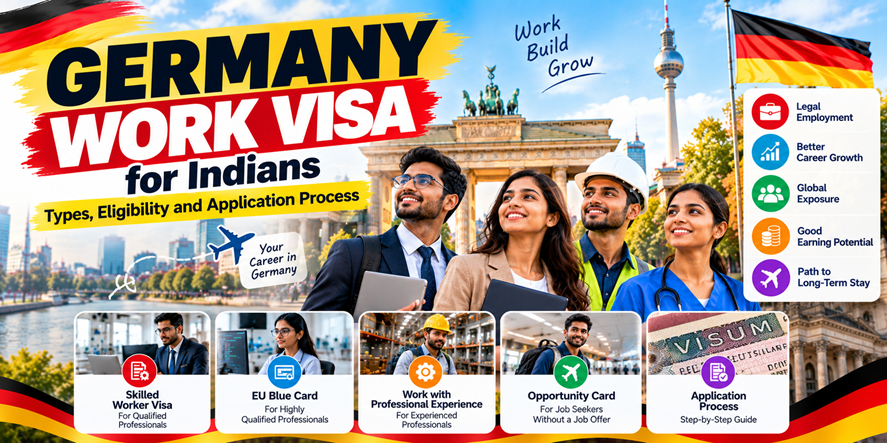
Germany's main pathways include the skilled worker visa, EU Blue Card, employment routes for certain experienced professionals, and the Opportunity Card for eligible jobseekers.

Intended for eligible applicants with a recognised university degree or qualified vocational training and a suitable offer of qualified employment in Germany.
Best suited for: Graduates, qualified technicians, engineers, and other skilled professionals.

A residence route for eligible highly qualified professionals with a qualifying job offer and salary. Applicants must satisfy the applicable qualification and salary rules.
Best suited for: Eligible university graduates and certain experienced IT professionals.

Certain applicants may qualify for employment in non-regulated professions based on their professional qualifications and relevant experience, even when their qualification has not undergone the standard German recognition process.
Best suited for: Eligible experienced professionals whose qualifications and job offer meet the specific rules.
This pathway allows eligible applicants to enter Germany to look for employment without already holding a job offer. Qualification, language, points where applicable, and proof of financial support are important.
Best suited for: Eligible jobseekers who want to search for suitable work in Germany.
These routes are not interchangeable. If you already have a job offer, you should normally assess the relevant employment visa category rather than assume the Opportunity Card is the right choice.
The requirements depend on your chosen route. Use the following as an initial guide.
Requirement | What to check |
|---|---|
Educational qualification | Whether your degree or vocational qualification meets the relevant route's rules |
Job offer | Whether the role and employment contract satisfy the visa category |
Work experience | Whether your occupation and route require documented experience |
Qualification recognition | Whether formal recognition, comparability, or a professional licence is required |
Salary | Whether your contract meets any applicable minimum salary threshold |
Language skills | Whether German or English proof is required for your route or profession |
Financial resources | Whether you can cover expenses where proof of funds is required |
Health insurance | Whether you have the required insurance coverage |
Documents | Whether your application includes the specified forms, certificates, and supporting evidence |
For a skilled worker visa, the job generally needs to be qualified employment, and the qualification must meet the applicable recognition or comparability requirements. Regulated professions can have additional licensing requirements.
You may wish to explore the Opportunity Card if you meet its requirements. Depending on your eligibility route, the assessment may involve recognised qualifications, language skills, professional experience, age, and points.
Applicants must also demonstrate the required financial support. The Opportunity Card is not a job guarantee, and finding employment will depend on the suitability of your profile and the vacancies available.
The EU Blue Card has specific gross annual salary thresholds. For 2026, Germany's official information lists the following thresholds:
Gross annual salary for qualifying shortage-occupation and certain new-entrant cases
Source: Germany's official Skilled Immigration Act information for 2026. Eligibility and any additional approvals depend on the individual case.
Meeting the salary threshold alone is not enough. Your qualifications, job offer, and other applicable conditions must also be satisfied.
These figures are specific to the EU Blue Card and should not be applied automatically to every German work visa.
Your opportunities will depend on your skills, qualifications, German-language ability, and employer demand. Some sectors Indian applicants may research include:

Information Technology
Software development, cloud computing, cybersecurity, data analytics, and related technical roles.

Engineering and Manufacturing
Mechanical, electrical, automation, quality, and industrial engineering roles.

Healthcare
Certain nursing, medical, and allied health roles, subject to qualification recognition, licensing, and language requirements.

Logistics and Supply Chain
Supply chain coordination, logistics planning, warehouse systems, and suitable qualified operational roles.

Energy and Sustainability
Renewable energy, electrical systems, environmental technology, and related engineering fields.
Treat these as fields to investigate, not a promise of immediate vacancies or visa eligibility. Check actual job descriptions and the qualifications employers require.
The following sequence is a useful starting point for applicants planning a move for employment.
Choose the correct visa route
Determine whether your profile fits the skilled worker visa, EU Blue Card, employment-with-experience route, Opportunity Card, or another category.
Check your qualification
Review the recognition or comparability requirements. For regulated professions, investigate the relevant professional licence.
Find a suitable employer or job opportunity
If applying for a job-based route, verify the employer, role, salary, and employment contract. If applying through the Opportunity Card, research job prospects before travelling.
Prepare your documents
Commonly requested documents include a valid passport, application forms, CV, certificates, employment contract where applicable, and proof of qualifications and experience. The exact checklist varies by visa category.
Apply through the official German visa process
Follow the German Missions in India instructions and the Consular Services Portal where applicable. Select the mission responsible for your place of residence.
Attend any required appointment and await a decision
Submit the documents and attend the appointment or other steps required for your category. Do not make irreversible travel plans until your visa is approved.
Complete the post-arrival formalities
After arrival, follow the conditions of your visa and apply for the relevant residence permit within the required period if necessary.
Official application information: German Missions in India — National Visa. The missions state that applicants do not need to use an agent to apply and that official forms and information are available free of charge.
Depending on your visa category, prepare to provide some or all of the following:
Valid passport and required passport photographs
Completed application forms and declarations
CV and employment history
University degree, vocational certificate, and transcripts where required
Qualification recognition or comparability evidence, if applicable
Signed employment contract or qualifying job offer, where required
Employer declarations or additional documents specified by the checklist
Proof of relevant work experience
Health insurance evidence
Proof of financial resources, where required
Language certificates or professional licences, where applicable
Do not assume that a checklist for one employment visa applies to every other category. Use the current checklist for your specific route and responsible German mission.
The answer depends on the job and immigration route.
IT and some international business roles: Some employers operate in English, but German may broaden your opportunities.
Engineering and manufacturing: Language requirements vary by role, employer, and workplace.
Healthcare and other regulated professions: German-language proficiency and professional recognition may be essential.
Opportunity Card applicants: Language skills may be part of the eligibility assessment, depending on the route used.
Do not assume that every work visa requires B1 or B2 German—or that an English-speaking employer removes every language requirement. Check the official rules for your category and the practical requirements of your intended job.
Paying for a job guarantee: No private agency can guarantee a German visa or employment outcome.
Using a tourist visa to start work: A short-stay Schengen visa does not authorise taking up employment in Germany.
Ignoring qualification recognition: Some occupations require formal recognition or a licence.
Applying under the wrong category: A job offer, professional qualification, and Opportunity Card have different requirements.
Trusting unverified recruiters: Verify company details, contact information, the job description, and contract terms.
Ignoring salary conditions: Some visa categories have minimum salary requirements; others operate under different rules.
Submitting inaccurate documents: False information or forged documents can result in refusal and further consequences.
Assuming a visa leads to permanent residence automatically: Future residence options depend on the relevant legal conditions and your circumstances.
Your situation | Route to investigate |
|---|---|
You have a qualifying job offer and recognised qualifications | Skilled worker visa or another applicable employment route |
You have a qualifying degree and meet the salary and other conditions | EU Blue Card |
You have relevant professional experience and a qualifying offer | Employment route for experienced professionals |
You do not yet have a job offer but meet the jobseeker route's conditions | Opportunity Card |
You want to complete vocational training in Germany | Vocational training visa rather than a standard employment visa |
This is an initial guide only. Use the official visa portal to determine the route that applies to your exact profile.
Germany has multiple immigration routes for qualified international workers, but the correct pathway depends on your qualifications, experience, employment plans, and eligibility.
Before applying, verify your qualification, research genuine employers, check the current visa conditions, and prepare the documents listed by the relevant German mission. If you do not yet have a job offer, investigate whether the Opportunity Card is suitable for your circumstances.
A well-researched application is a stronger starting point than promises of guaranteed jobs or visas.
EFOS – Education Future One Stop helps students and aspiring professionals explore education pathways, vocational training, and international career opportunities.
For career guidance and information about suitable pathways, contact EFOS:
Phone: +91 9403890820
Website: https://efos.in/
Disclaimer: This article is for general career-awareness purposes and is not legal or immigration advice. Visa rules, salary thresholds, document checklists, and eligibility criteria may change. Verify current requirements with official German authorities before applying or making payments.