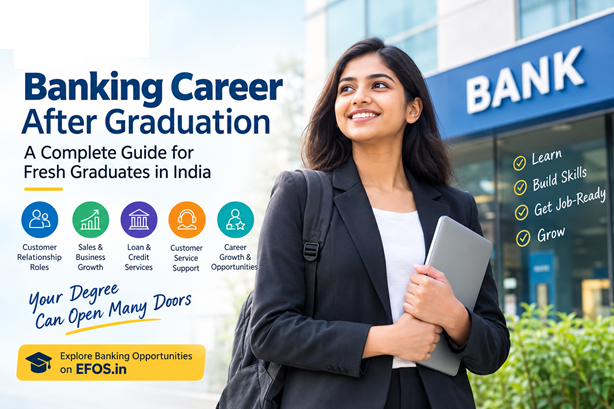
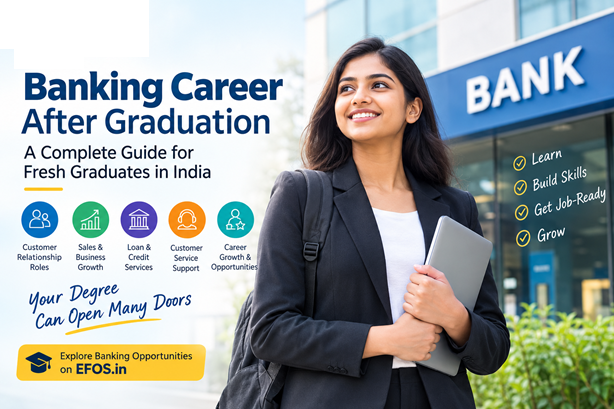
Graduation is an important milestone, but for many students it also brings a big question: What should I do next?
If you are looking for a professional career with structured growth, customer interaction, learning opportunities and the chance to work with leading financial institutions, banking can be an excellent career option after graduation.
The banking industry is no longer limited to traditional counter-based jobs. Today, banks need young professionals for customer relationship management, sales, loans, digital banking, branch operations, credit, customer service and many other functions.
Whether you have completed a B.Com, BBA, BA, B.Sc, BCA, B.Tech or another recognised graduation program, there are several pathways to begin a career in banking.
Banking is one of the sectors where graduates from different academic backgrounds can build successful careers.
For fresh graduates, some of the major advantages include:
Opportunities to start a career soon after graduation
Structured training and professional development
Exposure to customers, finance and business
Performance-based career growth
Opportunities to develop sales and relationship-management skills
Experience with financial products and digital banking
Career opportunities across cities and towns in India
Most importantly, banking can provide graduates with valuable professional experience at the beginning of their careers.
Relationship management is an important function in retail banking.
A Relationship Manager or Relationship Officer works with customers, understands their financial requirements and helps them identify suitable banking products and services.
The role may involve:
Customer acquisition
Maintaining customer relationships
Understanding customer financial requirements
Explaining banking products
Supporting account opening and documentation
Cross-selling suitable financial products
Working towards assigned business targets
This career can be particularly suitable for graduates who enjoy meeting people, communicating and building professional relationships.
Sales is one of the major entry points into private-sector banking.
Banking Sales Officers may work with products such as:
Savings and current accounts
Personal loans
Business loans
Credit cards
Insurance and investment products
Other retail banking services
This type of role can help freshers quickly develop communication, negotiation, customer-handling and business-development skills.
Customer Service Executives help customers understand and use banking services.
Their responsibilities can include resolving customer queries, assisting with banking processes, supporting documentation and coordinating with different departments.
Graduates with patience, communication skills and a customer-focused attitude can consider this career path.
Banks and financial institutions offer different credit products to individuals, farmers and businesses.
Fresh graduates may find entry-level opportunities involving personal loans, home loans, vehicle loans, business loans, agricultural finance and other credit products.
With experience, candidates can progress towards roles involving credit assessment, relationship management and team leadership.
Graduates interested in public-sector banking can also prepare for competitive recruitment examinations such as IBPS PO and SBI PO.
A Probationary Officer typically receives training across different areas of banking before taking on greater operational and managerial responsibilities.
This pathway requires dedicated competitive-exam preparation and is different from direct recruitment opportunities commonly available in private-sector banks.
Fresh graduates should understand that there are two major routes into banking.
Government/Public-Sector Banking: Recruitment generally takes place through competitive examinations. Candidates need to prepare for subjects such as quantitative aptitude, reasoning, English and banking awareness.
Private-Sector Banking: Many entry-level positions are filled through direct recruitment, campus hiring, training-linked recruitment and job interviews. Communication skills, customer orientation and sales ability can play an important role.
Neither route is automatically better for everyone.
Your choice should depend on your career goals, strengths and willingness to prepare for competitive examinations or begin working directly in a customer-facing banking environment.
A degree can make you eligible for many opportunities, but employers also look for workplace-ready skills.
Fresh graduates should focus on developing:
Communication Skills: You should be able to communicate professionally with customers and colleagues.
Customer Relationship Skills: Banking is built around trust. Understanding customer requirements and maintaining professional relationships are essential.
Sales Skills: Many retail banking positions involve business targets and customer acquisition.
Basic Financial Knowledge: Understand common banking products such as savings accounts, current accounts, fixed deposits, loans, credit cards and digital banking services.
Digital Skills: Modern banking depends heavily on technology. Basic computer skills and familiarity with digital financial services are increasingly important.
Professional Behaviour: Discipline, punctuality, integrity and appropriate workplace communication can significantly influence career growth.
No.
A common misconception among students is that only B.Com or finance graduates can enter banking.
Many customer-facing and entry-level banking roles are open to graduates from different academic streams, subject to the eligibility requirements of the particular employer or recruitment program.
Students from arts, science, commerce, management, engineering and technology backgrounds can explore banking opportunities.
What matters is developing the right combination of communication, customer service, financial awareness, sales ability and professional skills.
If you want to enter banking after graduation, start preparing before sending applications everywhere.
First, create a professional one-page resume highlighting your education, internships, communication abilities, computer knowledge and relevant achievements.
Next, learn the basics of banking products and terminology. Understand KYC, savings and current accounts, deposits, loans, interest rates, credit cards and digital banking.
You should also practise common interview questions such as:
Why do you want to work in banking?
Why should we hire you?
Are you comfortable interacting with customers?
Are you comfortable with sales targets?
What do you know about our bank?
What is the difference between a savings and current account?
How would you convince a customer to consider a banking product?
Finally, apply only after carefully checking the job description, eligibility criteria, location, employer and recruitment conditions.
EFOS – Education Future One Stop helps young people explore education, skill-development and employment opportunities.
EFOS currently features opportunities for graduates interested in starting careers in retail banking, including sales and relationship-management roles.
Instead of simply searching for “any job after graduation,” candidates can focus on building the skills required for a long-term professional career.
If you are a graduate looking to enter banking, explore the latest opportunities available on EFOS.in, understand the eligibility requirements and take the first step towards becoming job-ready.
Your first job does not have to be your final destination. It should give you an opportunity to learn, perform and grow.
Banking can provide fresh graduates with exposure to customers, finance, technology, sales and business operations. The experience gained during the first few years can create pathways towards relationship management, branch banking, credit, operations, wealth management and leadership roles.
So, if you have recently completed your graduation and are wondering what comes next, a career in banking could be worth exploring.
Graduate. Build Skills. Get Job-Ready. Grow Your Career with EFOS.