EFOS Career in Germany Ser
Germany is an attractive destination for Indian students and young professionals who want to build international careers. But before planning your journey, one important question needs to be answered:
Should you choose Ausbildung in Germany or pursue a university degree?
Both options can help you develop valuable skills, gain international exposure, and explore career opportunities in Germany. However, they differ in their learning methods, costs, qualifications, language requirements, and long-term career possibilities.
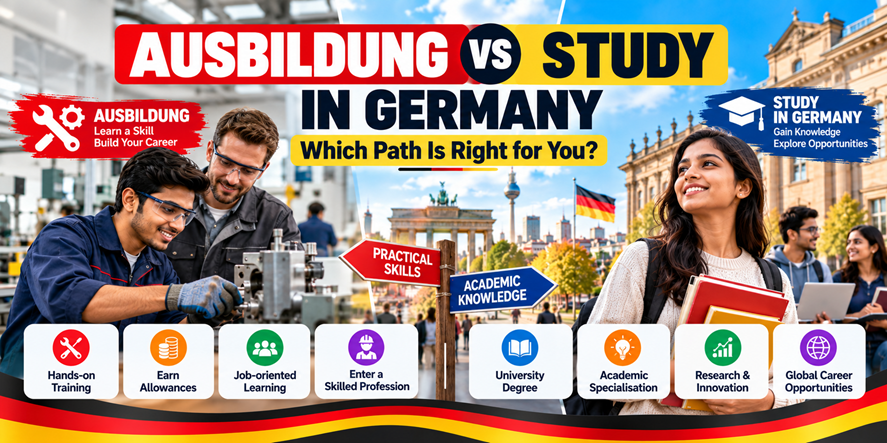
Ausbildung is generally suited to people who prefer practical, job-focused training and want to learn a profession while receiving a training allowance in company-based programmes. University study may be more suitable for those who want an academic degree, specialised knowledge, or careers requiring higher education qualifications.
There is no single best option for everyone. The right decision depends on your education, financial situation, interests, German-language skills, and future career goals.
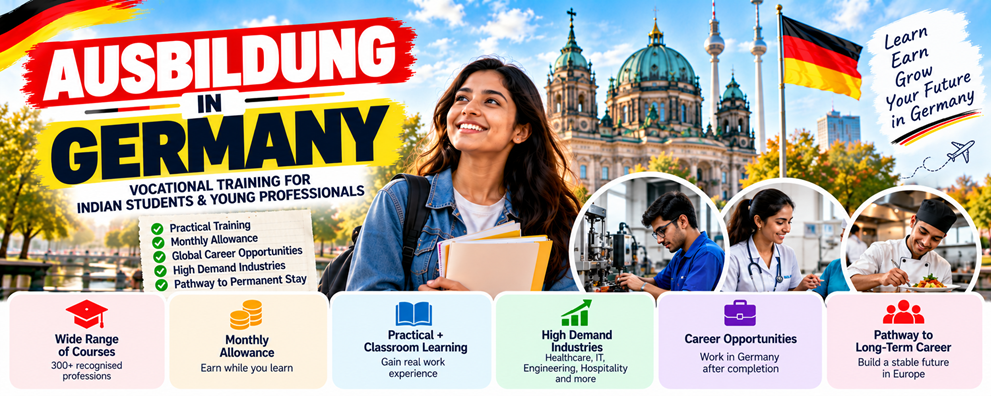
Ausbildung is Germany's vocational training system, designed to prepare people for specific professions through structured training and practical learning.
In the popular dual Ausbildung model, trainees combine workplace experience with classroom learning at a vocational school. The training is connected to a particular occupation, such as hospitality, retail, logistics, technical trades, or certain healthcare-related professions.
The programme usually lasts around two to three-and-a-half years, depending on the occupation and training structure.
Practical learning: Develop skills by working in a real professional environment.
Classroom education: Study occupational theory alongside practical training.
Training allowance: Company-based trainees generally receive a monthly training allowance, with the amount varying by occupation, employer, training year, and applicable agreements.
Career-focused preparation: Training is designed around the skills needed for a specific profession.
Employment possibilities: Successful graduates may apply for qualified jobs, subject to employer requirements and applicable residence rules.
Germany also offers school-based vocational training. Its funding and financial arrangements can differ from company-based dual Ausbildung, so students should check the exact programme before applying.
Ausbildung may suit you if:
You prefer practical learning over a highly academic classroom experience.
You want to develop skills for a specific occupation.
You are comfortable learning and working in German.
You want to gain workplace experience during your training.
You are interested in a structured route into a skilled profession.
Remember, Ausbildung is not simply a shortcut to Germany. You generally need a genuine training position, suitable language skills, and sufficient financial resources to meet the applicable visa requirements.

University study in Germany focuses on academic education, specialised knowledge, research, and the development of professional or technical expertise.
Depending on your previous education and chosen programme, you might pursue a bachelor's degree, master's degree, or another recognised qualification.
Popular study areas include:
Computer Science and Information Technology
Engineering and Manufacturing
Business Administration and Management
Data Science and Artificial Intelligence
Renewable Energy and Environmental Sciences
Life Sciences and selected healthcare-related fields
Academic learning: Build theoretical knowledge and analytical skills.
Specialisation: Study a subject in greater depth.
Research opportunities: Some programmes provide access to research projects, laboratories, and advanced academic work.
Internships: Certain programmes include internships or practical semesters.
Career flexibility: A recognised degree may qualify you to pursue a wider range of professional or postgraduate pathways, depending on the subject and job requirements.
Admission depends on the qualification you already hold, whether it is recognised for German higher education, your grades, and the requirements of your chosen institution. Some Indian applicants may need additional study or a preparatory course such as a Studienkolleg.
The following comparison highlights the main differences for Indian applicants.
Factor | Ausbildung | University study |
|---|---|---|
Main purpose | Preparation for a specific occupation | Academic and professional education |
Learning style | Practical training plus vocational classes | Lectures, assignments, exams and sometimes practical training |
Typical duration | Around 2–3.5 years, depending on the occupation | Bachelor's degrees often take 3–4 years; master's degrees commonly 1–2 years |
Income during training | Company-based programmes generally pay a training allowance | Students normally fund their studies; eligible students may have permitted part-time work |
Tuition and fees | Depends on training type and programme | Varies by institution, state and programme |
German language | B1 is generally relevant to the vocational training visa, subject to applicable exceptions; employers may expect more | Depends on the programme; many German-taught degrees require at least B2 or a higher level |
Admission | A suitable training position and programme-specific requirements | Recognised academic qualifications and programme-specific admission criteria |
Career focus | Direct preparation for a defined occupation | Broader academic knowledge and subject specialisation |
Further progression | Skilled employment and further vocational development | Employment, postgraduate study and, where relevant, research |
The duration and requirements above are general guides, not universal rules. Always verify the requirements for your chosen occupation, university, course, and visa category.
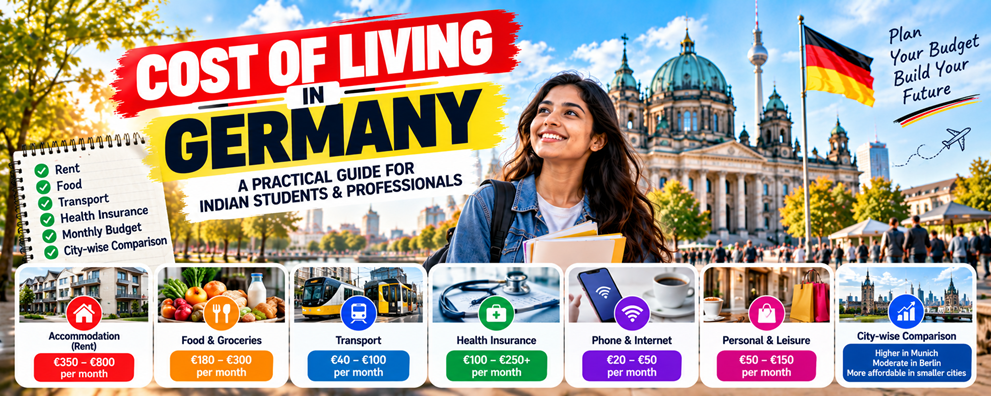
Cost is often one of the most important considerations for Indian families planning an international education or training journey.
However, a lower tuition fee does not automatically mean a lower total cost. You must consider accommodation, food, health insurance, transport, visa-related expenses, language preparation, and other living costs.
In company-based dual Ausbildung, the trainee generally receives an allowance during the training period. This can help cover everyday expenses.
Nevertheless, the allowance may not cover all living costs, particularly in expensive cities. The amount also depends on the occupation, employer, training year, and applicable agreements.
For a vocational training visa, Germany's official guidance sets financial requirements. For 2026, company-based trainees generally meet the livelihood threshold through an allowance of at least €1,048 gross or €822 net per month; if the allowance is insufficient, additional proof of funds may be needed. School-based training has different financial requirements. Check the current official rules before applying.
Many bachelor's and master's programmes at German public higher education institutions do not charge general tuition fees. However, there are exceptions.
For example, public universities in Baden-Württemberg generally charge non-EU students €1,500 per semester for many degree programmes, and some universities in Bavaria also charge tuition fees to international students. Private institutions can charge substantially more.
Students also pay semester contributions, which vary by institution. The DAAD reports that these commonly range from €70 to €430 per semester. Its published guidance estimates living costs at approximately €900–€1,200 per month, although actual expenses depend on the city and individual lifestyle.
Which is financially better?
Ausbildung may be more manageable if you secure a paid company-based position and your allowance covers a reasonable share of your expenses.
University study may be attractive if you secure admission to a suitable public programme with low or no tuition fees and have a reliable plan for living expenses.
Neither option is automatically free. You should calculate the full cost of your chosen pathway before committing.
German language ability can significantly affect your application, classroom experience, and career prospects.
For the vocational training visa, German at B1 level is generally required when the training institution has not already assessed your language skills or the relevant exception does not apply.
However, the employer, vocational school, or specific occupation may expect a higher level. Customer-facing jobs and some healthcare-related occupations may require stronger communication skills.
For many German-taught university programmes, B2 or a higher level may be required. The exact standard depends on the institution and programme.
Some international programmes are taught in English. These may require proof of English proficiency instead, although learning German remains valuable for everyday life, internships, and future employment.
Practical advice: Do not select a programme based only on the lowest language level advertised. Check which certificates are accepted, the minimum score required, and whether the level must be achieved before admission or visa application.
Ausbildung can prepare you for occupations in which practical skills and recognised vocational qualifications are important.
Potential fields include:

Hospitality and Tourism
Hotel operations, guest services, food service, and other hospitality-related roles.

Warehouse operations, logistics processes, retail operations, and commercial services.

Technical and Industrial Trades
Mechanical, electrical, manufacturing, and other occupation-specific technical roles.

Healthcare and Care Professions
Certain recognised vocational pathways in nursing and care, subject to their specific entry, language, and professional requirements.
The availability of training positions varies by occupation, location, employer, and intake. Completing Ausbildung does not guarantee a job, a particular salary, or permanent residence.
After successfully completing vocational training, eligible graduates may be able to stay in Germany for up to 18 months to seek qualified employment, subject to the applicable residence rules.
A university degree may be a better fit for students who want to develop advanced academic knowledge or enter professions where a degree is commonly required.
Potential career areas include:
IT and Software: Software development, data analysis, cybersecurity, and related roles.
Engineering: Mechanical, electrical, automotive, and industrial engineering.
Business and Finance: Business analysis, accounting-related roles, management, and finance.
Science and Research: Laboratory work, research support, and further academic study.
Energy and Sustainability: Renewable energy, environmental engineering, and related technical fields.
Your actual opportunities will depend on your degree, practical experience, language skills, employer requirements, and the state of the job market when you graduate.
International graduates may qualify for residence options to seek employment after completing a degree in Germany. The exact conditions and permitted duration should be checked against current official immigration guidance.
If you have completed Class 12 in India, both routes may be worth exploring, but they involve different eligibility checks.
A Class 12 certificate does not automatically qualify every applicant for direct admission to every German university. Academic recognition, subject requirements, grades, and any preparatory study requirements must be checked individually.
Similarly, Ausbildung applicants must meet the requirements of their chosen training programme and employer. Do not assume that every occupation accepts the same academic background or language level.
9. Can You Study in Germany Without Knowing German?
It may be possible to pursue an English-taught university programme without meeting the German-language requirements for a German-taught course. You will still need to satisfy the programme's English-language and academic requirements.
Ausbildung usually requires more German-language preparation because trainees need to understand vocational classes, workplace instructions, safety procedures, and professional communication.
Even if your university course is taught in English, learning German can help you navigate everyday life and expand your opportunities for internships and employment.
The better question is not simply whether German is compulsory. It is which language skills your chosen pathway requires for successful learning and employment.
Before choosing either route, avoid these common mistakes:
Choosing only on the basis of cost: Compare the complete cost of living and learning, not just tuition fees.
Assuming Ausbildung guarantees a job: A training position is not a promise of permanent employment.
Assuming every public university is tuition-free: Fees can vary by state, university, and programme.
Ignoring language requirements: A language level that meets a visa rule may not be enough for every employer or institution.
Applying without checking qualifications: Confirm academic recognition and occupational entry criteria before paying application or counselling fees.
Trusting guaranteed visa claims: No counsellor or agency can guarantee that a visa will be approved.
Selecting a career without research: Understand the actual duties, working conditions, progression opportunities, and requirements of your intended occupation.
Ask yourself these five questions before making your decision.
1. What type of learning do you prefer?
2. What qualification are you aiming for?
3. Are you prepared to learn German?
4. How will you fund your stay?
5. What is your main career goal?
This guide provides an initial direction, not an admission or visa eligibility decision.
Ausbildung and university study can both lead to valuable opportunities in Germany, but they serve different goals.
Choose Ausbildung if you prefer practical learning, want to prepare for a specific occupation, and are interested in a structured vocational training route.
Choose university study if you want an academic degree, deeper subject specialisation, or a career pathway that benefits from higher education.
Before making a decision, check your eligibility, compare the full costs, research genuine programmes, and prepare for the relevant language requirements. A realistic plan is more valuable than choosing a route based on promises of guaranteed jobs or visas.
EFOS – Education Future One Stop helps students and aspiring professionals explore education pathways, vocational training options, and career opportunities.
Contact EFOS for career guidance and information about suitable pathways.
Phone: +91 9403890820
Website: https://efos.in/
Disclaimer: This article is intended for general information and career awareness. Admission, training, employment, financial, and immigration requirements can change. Verify current requirements directly with the relevant university, employer, and official German authorities before making decisions or payments