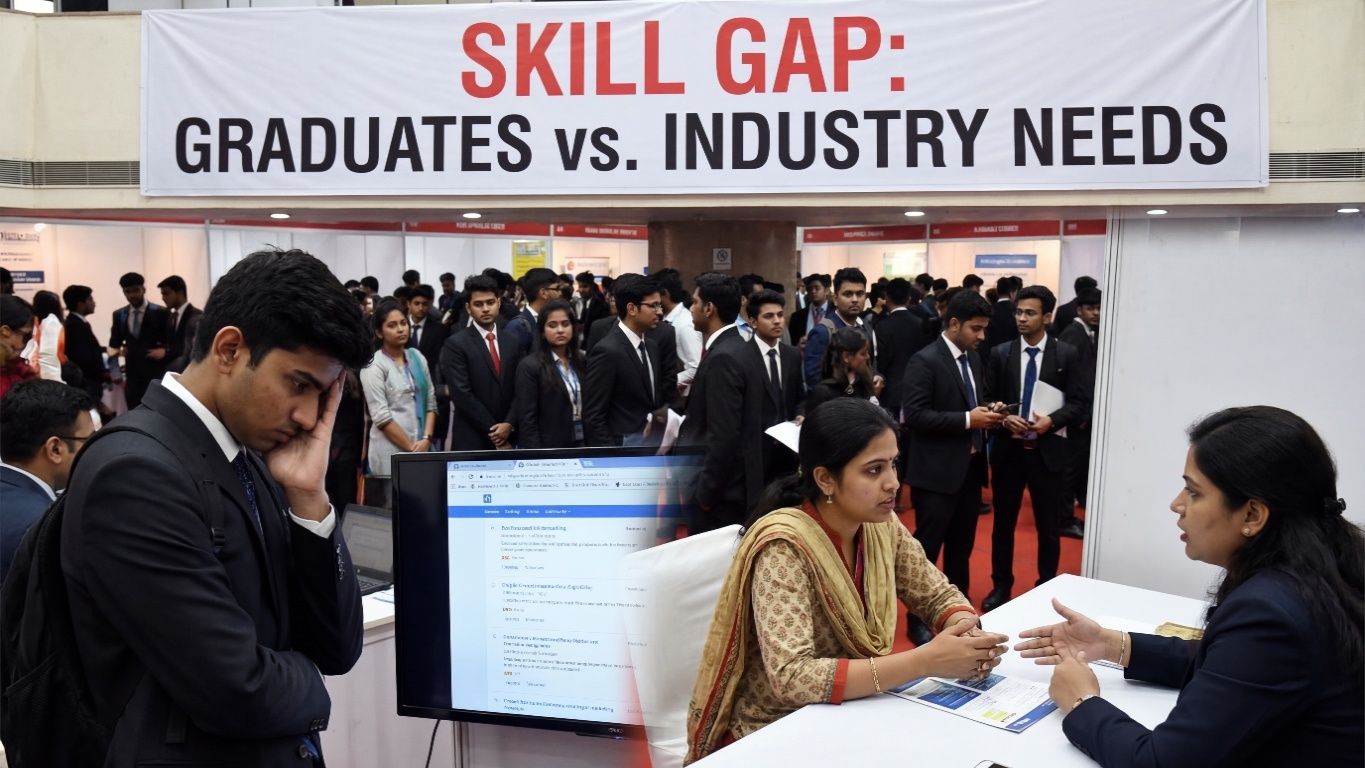
We’ve all seen the headlines. Millions of engineers, MBAs, and arts graduates pass out of Indian colleges every year, yet companies constantly complain that they "can't find talent."
It feels like a cruel joke. You spent 3 or 4 years burning the midnight oil, submitting assignments, and passing exams—so why does the rejection email say, "You aren't a right fit"?
The answer usually isn't about your intelligence or your grades. It’s about the Skill Gap. Let’s break down exactly what that is, why it’s happening, and most importantly, how you can bridge it to land your dream job.
1. What Exactly is the "Skill Gap"?
Imagine you read a book on how to swim. You memorize the physics of buoyancy and the biomechanics of the freestyle stroke. You ace a written test on swimming with 98%.
Then, someone throws you into a pool. You will likely sink.
That is the skill gap.
In India, our education system is fantastic at teaching theory, but the corporate world doesn't pay for definitions; they pay for application.
If you are a fresh graduate struggling to get hired, you are likely missing one (or all) of these three critical areas.
This is the number one complaint from recruiters. You might be a coding wizard or a finance guru, but if you cannot communicate your ideas clearly, work in a team without fighting, or send a professional email, you become a liability.
Fact: According to the India Skills Report, English communication and adaptability are often cited as the top missing traits in freshers.
Technology moves fast. Universities move slow. While you were studying the history of C++ or marketing theories from 1990 in your classroom, the industry moved on to Python, AI, Digital Marketing, and Agile methodologies.
We are trained to memorize. "Memorize this definition, vomit it out on the exam paper, forget it tomorrow." In a job interview, the interviewer won't ask, "Define a bubble sort." They will ask, "Here is a mess of data. Sort it efficiently and tell me why you chose that method." If you only memorized the definition, you are stuck.
3. The Difference: Campus vs. Corporate
Here is a quick comparison to help you understand the shift in mindset required.
| Feature | College Mindset | Corporate Mindset |
|---|---|---|
| Goal | Get good grades/pass exams. | Solve problems/make money/save time. |
| Structure | Syllabus is fixed. | Requirements change daily. |
| Teamwork | "I'll do it myself to get full marks." | "I need to collaborate to finish this project." |
| Failure | Failure is bad (F Grade). | Failure is a learning step (Iteration). |
Enough about the problem. Let’s talk about the solution. You don’t need to wait for the education system to change. You can fix this yourself.
Stop reading, start doing.
Use platforms like Coursera, Udemy, YouTube, or LinkedIn Learning. If your college syllabus doesn't cover the latest tools (like React, Tableau, or Figma), learn them online. A certification shows recruiters you are proactive and hungry to learn.
A student with 90% marks and zero experience is often less employable than a student with 70% marks and two internships. Internships teach you office culture, email etiquette, and real-world pressure handling. Even an unpaid internship is valuable if you are learning a core skill.
You’ve heard it before, but it’s true.
The "unemployable" label is harsh, but it’s not permanent. The fact that you are reading this means you are already aware of the problem, which puts you ahead of the pack.
The degree gets you to the interview door. Your skills get you the chair.