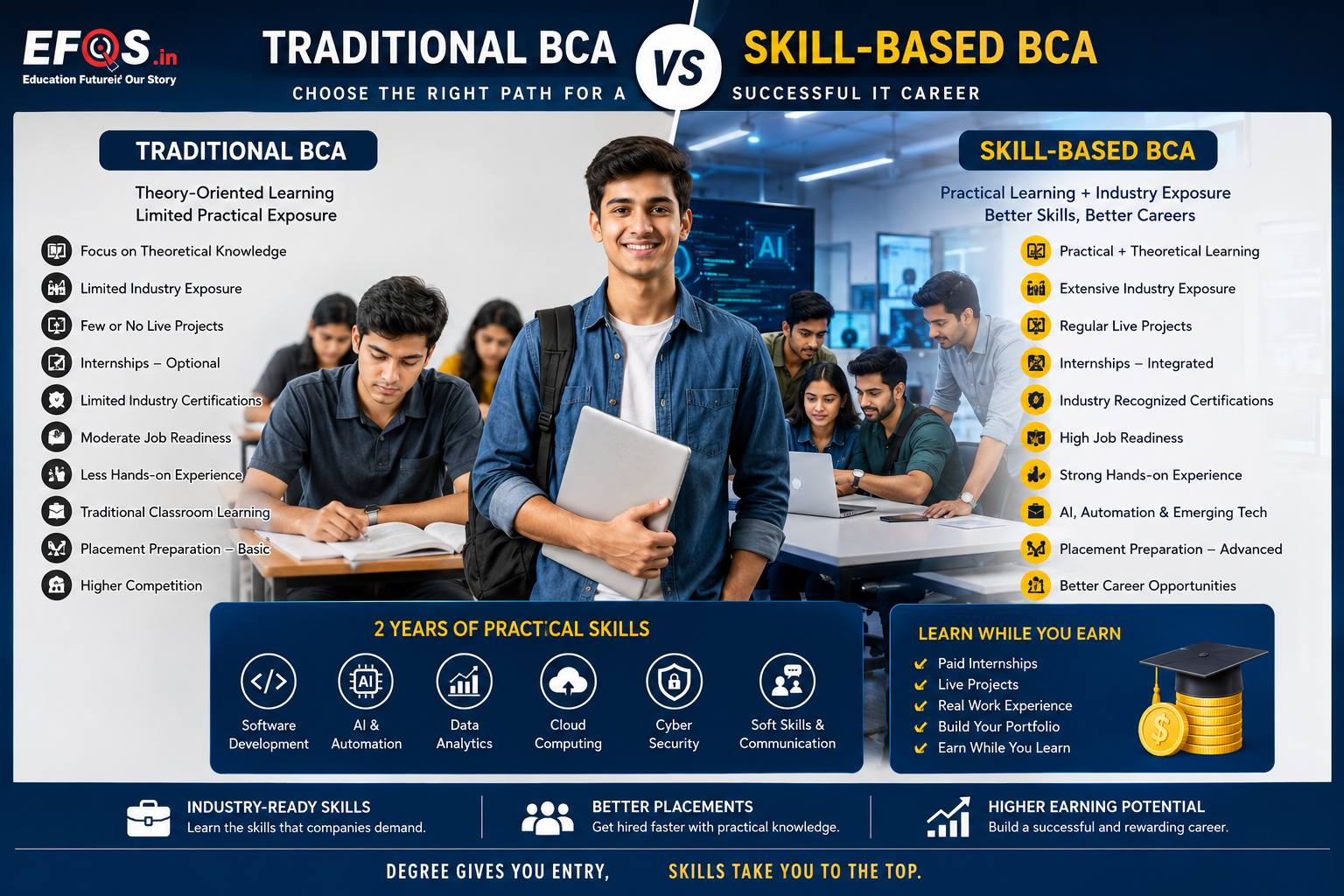
Choosing the right BCA program can significantly impact your career opportunities. While a Traditional BCA focuses mainly on theoretical knowledge, a Skill-Based BCA combines academic learning with practical training, industry projects, internships, and earning opportunities. In today's competitive job market, employers prefer candidates who possess both technical knowledge and hands-on experience. This makes Skill-Based BCA programs a more career-oriented choice for students aspiring to enter the IT industry.
Traditional BCA vs Skill-Based BCA
Which One is Better for Your Career?
The technology industry is evolving rapidly, and companies are no longer looking for candidates with only degrees. They need professionals who can apply their knowledge to solve real-world problems. This shift has led to the emergence of Skill-Based BCA programs that combine academic education with practical industry exposure. If you are planning to pursue a Bachelor of Computer Applications (BCA), understanding the difference between a Traditional BCA and a Skill-Based BCA can help you make a better career decision.
What is a Traditional BCA?
A Traditional BCA program primarily focuses on classroom teaching and theoretical concepts related to computer applications and information technology.
Students learn subjects such as:
Programming Languages
Database
Management Systems
Computer Networks
Operating Systems
Software Engineering
Web Technologies
What is a Skill-Based BCA?
A Skill-Based BCA is designed to bridge the gap between education and employment. Along with academic learning, students receive extensive practical training, industry certifications, live projects, internships, and workplace exposure.
These programs focus on:
Practical Skill Development
Industry-Oriented
Curriculum Live Projects
AI & Automation Tools
Full Stack Development
Cloud Computing
Data Analytics
Digital Skills
Professional Development
Students graduate with both a degree and real-world experience
Learn While You Earn
Many modern Skill-Based BCA programs include paid internships, apprenticeships, or work-integrated learning models. Benefits include: Earn while studying, Gain real-world work experience, Build a professional portfolio, Improve technical confidence, Reduce financial burden, Create industry connections.