The Bharat Mandapam was envisioned as a temple of "Viksit Bharat"—a high-tech stage where India would broadcast its arrival as a global AI superpower. Instead, at the India AI Impact Summit, it morphed into a theater of the absurd.
What began with a government-endorsed exhibition stall ended with a literal pull of the plug. As reports of "imitation masquerading as innovation" went viral, the university’s electricity was cut off (बत्ती भी काट दी गई), and they were unceremoniously expelled from the venue.
This wasn't just a PR blunder; it was a systemic collapse of academic integrity and national vetting protocols.
The Illusion of "In-House" Development
At the center of the storm was "Orion," a robotic dog presented with the gravity of a moon-landing project. University representatives claimed it was "developed" at their Center of Excellence.
The digital world, however, is unforgiving. Social media sleuths quickly identified "Orion" as a Unitree Go2—a mass-produced Chinese model available for 2-3 lakh INR. Similarly, the "homegrown" drone on display was identified as a Korean Striker V3 ARF model.
The audacity of the claim was staggering. Professor Neha Singh boasted that the university had invested over ₹350 crore in Artificial Intelligence. Yet, for all that capital, the "innovation" on display was a procurement receipt from a Chinese company.
When academic institutions conflate "shopping" with "shipping" a product, they don't just mislead the public—they betray the very students they claim to mentor.
"This is our Orion... it has been developed in the Center of Excellence at Galgotias University... its end-to-end engineering, from our soccer arena to its lab and execution area, is with us."
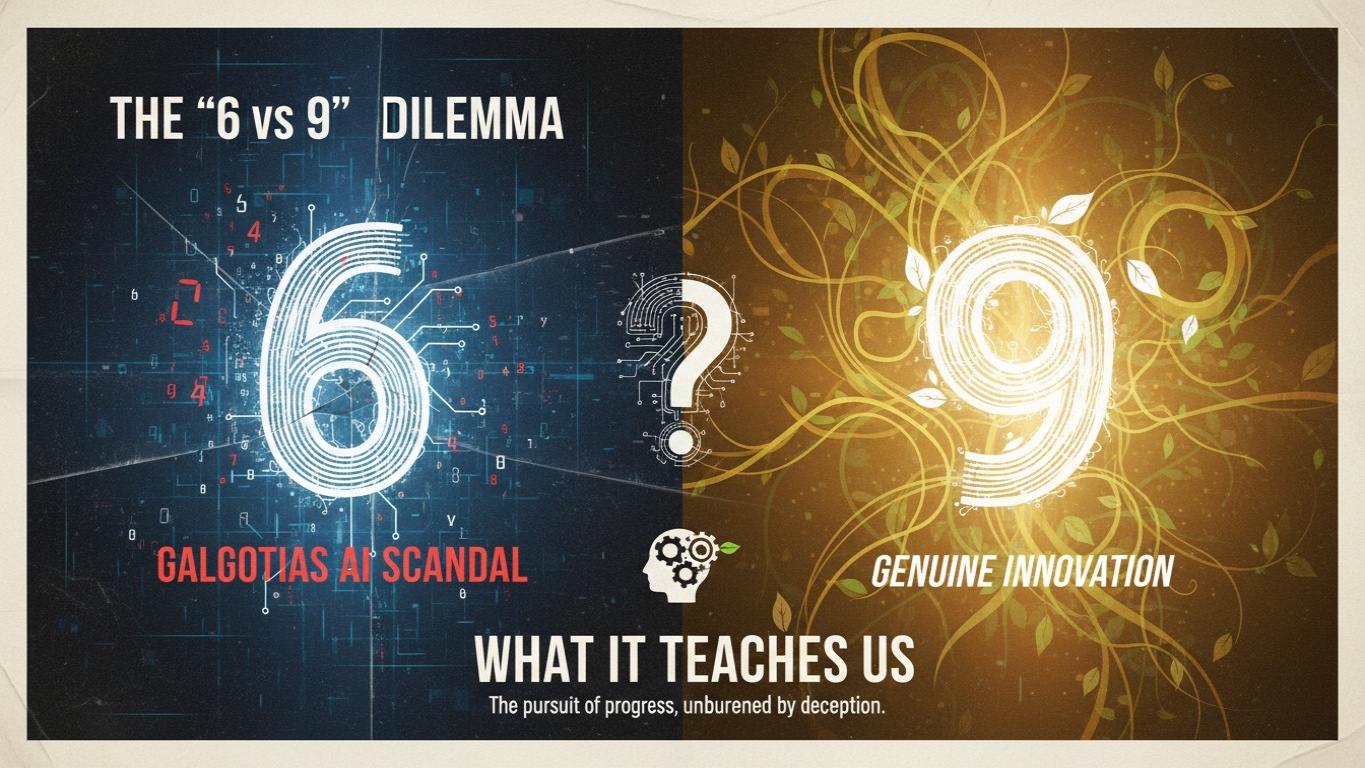
Linguistic Gymnastics and the "6 vs 9" Defense
As the scrutiny intensified, the university’s defense shifted from technical pride to condescending semantics. Professor Neha Singh’s rebuttal to journalists has already become a case study in rhetorical evasion.
She argued that the word "developed" does not necessarily imply "manufacturing." When pressed on her previous "end-to-end engineering" claims, she attempted a tactical retreat, suggesting those words referred specifically to the "soccer arena" where the robot plays, not the robot itself.
The highlight of this defense was her attempt to gaslight the observers:
"Your six can be my nine... Mislead is a very big word... you are journalists, you should use these words responsibly... A wrong misinterpretation has taken the internet by storm... We never claimed we manufactured it. Development does not mean designing and manufacturing."
This "6 vs 9" logic is a dangerous precedent. It suggests that truth in innovation is subjective—a matter of "perspective" rather than provenance.
The Cost of International Ridicule
The fallout was not confined to New Delhi. The "China Pulse" X account mocked the event, delighting in the irony of a Chinese robot being paraded as an Indian breakthrough.
The embarrassment reached the highest levels of the Indian cabinet. Union Minister Ashwini Vaishnaw was forced to delete his promotional tweet of the stall after it was slapped with a Community Note—the digital equivalent of a "liar" sign.
For "Brand India," the cost is immense. Every time a fraudulent innovation is promoted by the state, it dilutes the credibility of the thousands of genuine Indian engineers doing the grueling, unglamorous work of real R&D.
The Vetting Vacuum in High-Stakes Summits
The Galgotias incident reveals a terrifying lack of oversight. How did a university with a history of political posturing—remember the 2024 student protests against the Congress manifesto?—pass the technical screening for a national AI summit?
The organizers failed. If social media hadn't intervened, this "innovation" might have been endorsed by the Prime Minister himself, leading to a geopolitical humiliation of even greater proportions.
Currently, X’s Community Notes are doing the job that government vetting committees were supposed to do. When political optics take precedence over technical verification, we create a vacuum where showmanship thrives and science dies.
The $700 Billion Reality Check
The hunger for flashy presentations masks a sobering R&D deficit. In 2024, India’s total R&D spending was approximately 75.7billion∗∗.Incontrast,Chinaspent∗∗785.9 billion and the USA spent $781.8 billion.
This tenfold gap has real-world consequences. We see it in the Galgotias stall, and we see it in corporate giants like Reliance Industries, whose lithium-ion battery plans stalled precisely because they couldn't secure the necessary technology from China.
True innovation requires "indigenous brainpower," not just putting a university stamp on a foreign box. You cannot buy your way into the AI race with a credit card and a PR team.
Conclusion: Beyond the Buzzwords
The Galgotias scandal is a warning. It is the result of a culture that rewards the "look" of innovation over the "labor" of it. While our talent is world-class, our institutional honesty is lagging.
If we continue to treat procurement as creation, we are not building a "Viksit Bharat"; we are merely decorating a facade with imported parts.
In the race for AI supremacy, are we building creators of technology, or merely sophisticated consumers of it?