
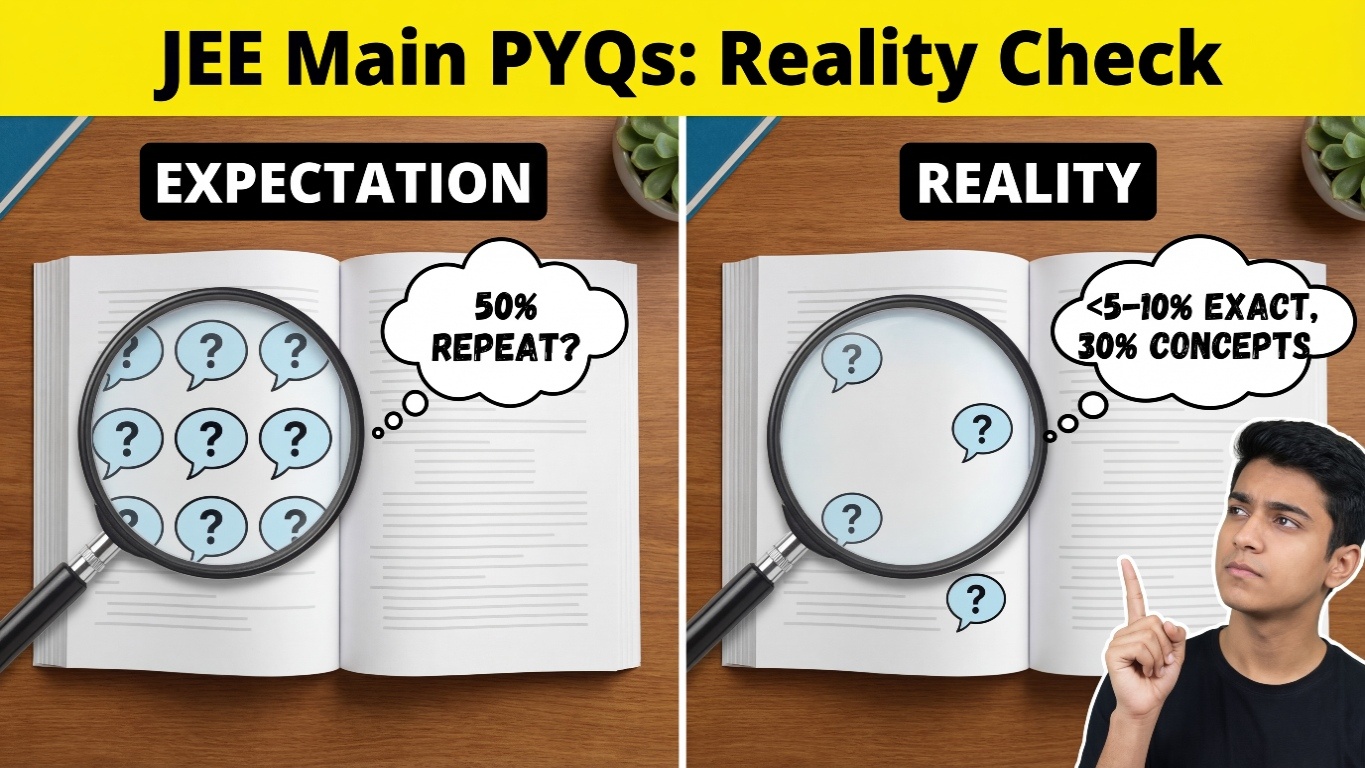
Preparing for JEE Main and wondering “Do questions really repeat?”
You’re not alone. This is one of the most common and important doubts among aspirants. Let’s break the truth in a clear, student-friendly way—no myths, only facts.
👉 Yes, but not exactly word-to-word.
In JEE Main:
Concepts repeat frequently
Question patterns repeat
Numerical values or framing may change
So instead of memorizing answers, understanding PYQs (Previous Year Questions) gives you a big advantage.
Based on analysis of the last 10–15 years of JEE Main papers:
🔹 20–30% questions are directly or indirectly repeated
🔹 60–70% questions are based on repeated concepts
🔹 Almost 80% of the paper comes from high-weightage PYQ topics
✅ This means PYQs are the backbone of JEE Main preparation.
Questions from Limits, Integration, Matrices, Probability
Similar patterns appear almost every year
Repetition level: Moderate to High
Strong repetition from:
Current Electricity
Modern Physics
Laws of Motion
Thermodynamics
Repetition level: High
Most predictable subject
Inorganic & Physical Chemistry show very high repetition
Named reactions and formula-based numericals often repeat
Repetition level: Very High
❌ “If I do PYQs, I don’t need theory.”
✔️ Wrong. PYQs help you apply theory, not replace it.
❌ “Only last 2 years PYQs are enough.”
✔️ Wrong. Minimum 10–15 years PYQs are recommended.
✔️ Solve chapter-wise PYQs after completing theory
✔️ Analyze why an option is correct or wrong
✔️ Mark repeated concepts & formulas
✔️ Revise PYQs at least 2–3 times before exam
✔️ Combine PYQs with mock tests
Understand exam mindset
Learn time management
Identify important chapters
Boost confidence
Avoid surprises on exam day
👉 Yes, JEE Main questions do repeat—but smartly.
Students who master PYQs don’t fear new questions because the concepts remain the same.
🔑 If you are serious about JEE Main, PYQs are not optional—they are compulsory.