
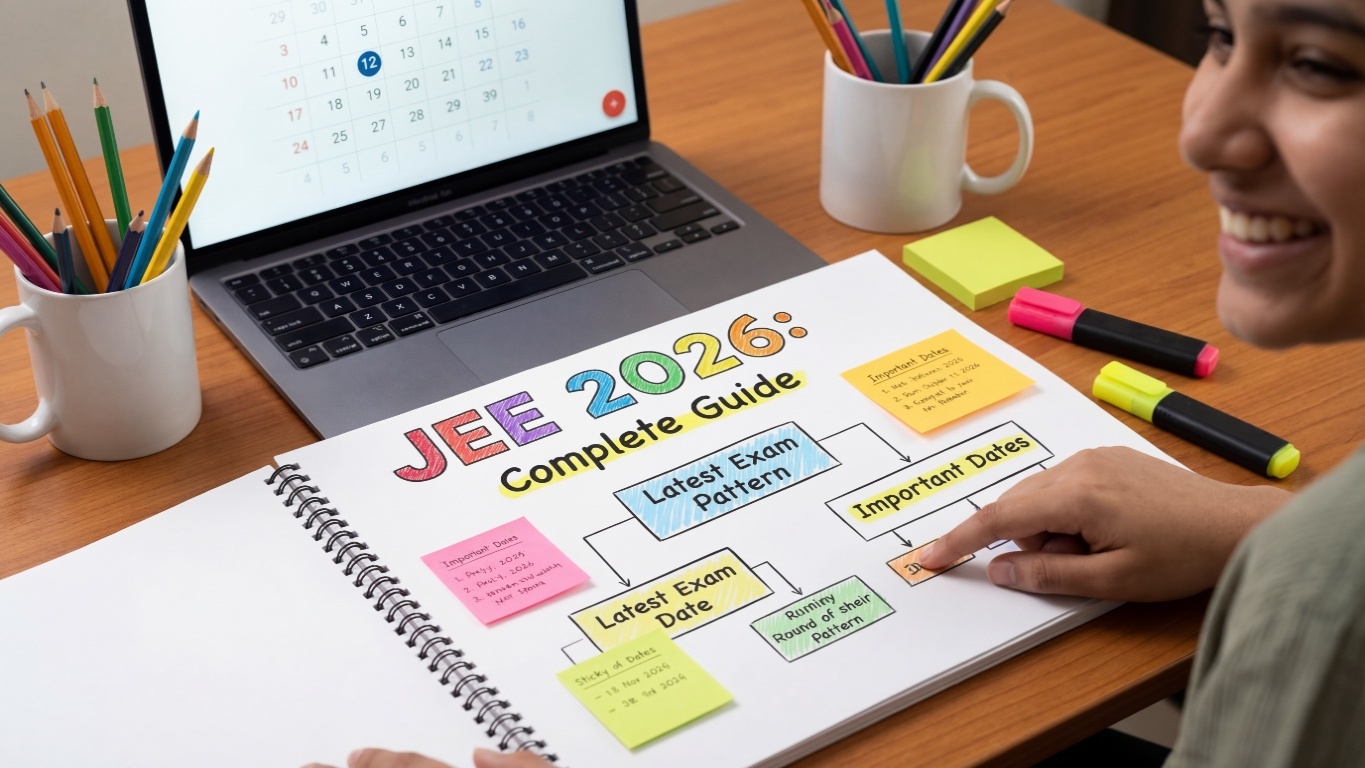
The Joint Entrance Examination (JEE) is India’s most competitive engineering entrance exam, opening doors to top institutes like IITs, NITs, IIITs, and other government-funded colleges. If you are preparing for JEE 2026, knowing the latest exam pattern and expected dates is the first step toward a focused and confident preparation.
JEE is conducted in two stages:
JEE Main – Conducted by the National Testing Agency (NTA). It is required for admission to NITs, IIITs, and other central institutions. JEE Main also acts as the eligibility test for JEE Advanced.
JEE Advanced – Conducted by IITs on a rotational basis, this exam is mandatory for admission into the prestigious IITs.
Based on previous years’ trends, JEE Main 2026 is expected to be conducted in two sessions:
Session 1: 21-30 January 2026
Session 2: 2-9 April 2026
Students can appear in both sessions, and the best score will be considered for ranking.
JEE Main is a computer-based test (CBT) with a total duration of 3 hours. The paper includes Physics, Chemistry, and Mathematics, with an equal weightage for all three subjects.
The exam consists of:
Multiple Choice Questions (MCQs)
Numerical value-based questions
Each correct answer carries +4 marks, while −1 mark is deducted for incorrect MCQs. Numerical questions usually do not have negative marking.
The total marks for the exam are 300.
The JEE Main syllabus is strictly based on NCERT Class 11 and Class 12 curriculum.
Physics: Mechanics, Thermodynamics, Electricity & Magnetism, Optics, Modern Physics
Chemistry: Physical, Organic, and Inorganic Chemistry
Mathematics: Algebra, Calculus, Coordinate Geometry, Trigonometry
NCERT textbooks should be your primary study resource.
Only the top JEE Main qualifiers (around 2.5 lakh candidates) are eligible for JEE Advanced.
JEE Advanced is conducted in CBT mode and consists of two compulsory papers, each of 3 hours. The exam includes multiple types of questions such as single correct MCQs, multiple correct MCQs, numerical questions, and match-the-following.
Unlike JEE Main, JEE Advanced does not have a fixed pattern, and the marking scheme may change every year.
Understanding the latest exam pattern helps students:
Plan preparation smartly
Manage time effectively during the exam
Reduce stress and uncertainty
Focus on high-scoring areas
Cracking JEE requires clarity, consistency, and correct guidance. Staying updated with the latest JEE 2026 exam pattern and dates gives you a strong foundation to plan your preparation strategically.
✨ Prepare smart, stay disciplined, and believe in your journey.