Lamrin Tech Skills University is quietly rewriting the rules of Indian higher education — with IBM in the boardroom, IIT Mandi in the classroom, and a mandate to make every graduate hireable on Day One.
By Our Education Correspondent | Ropar, Punjab | Published May 2025
Outlook 2024 — #6
Top Skill Universities in India
Education World Award
Digital Education Innovation 2026–27
Punjab's #1
Digital & Skill University
Best Skill University
National Recognition, Multi-Year
Top 6 Digital Universities
India-wide Digital Enablement Ranking
UGC Recognised
Under UGC Act 1956 · Punjab State Act No. 22 of 2021
500+Corporate Partners
4,000+MSME Connections
80 AcresShivalik Foothills Campus
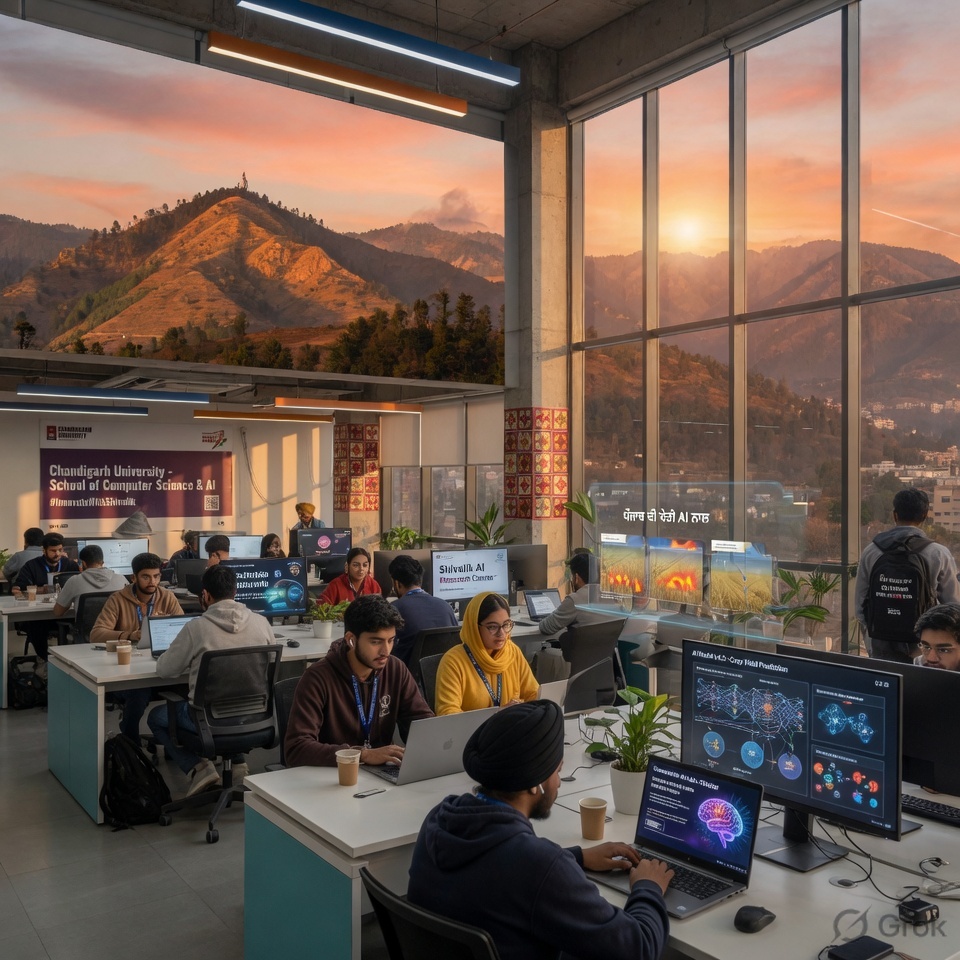
Tucked into the serene foothills of the Shivalik range, just forty minutes from Chandigarh and within earshot of the Satluj River, sits a university that does not quite look or feel like any other in India. There are no dusty lecture halls where theory is recited from yellowed notes. In its place: IBM-powered labs, live project briefs from Larsen & Toubro engineers, and a curriculum that gets rewritten every time industry rewrites its hiring needs.
This is Lamrin Tech Skills University Punjab — and in the four years since it was founded by the Government of Punjab under State Act No. 22 of 2021, it has managed to earn a string of recognitions that older, better-funded institutions might envy.
The numbers tell part of the story. Outlook, one of India's most respected education ranking bodies, placed LTSU at 6th position among India's top Skill Universities in 2024, evaluating it on parameters including teaching quality, graduation outcomes, inclusivity, and research environment. That ranking alone puts the university in the same breath as institutions with decades of headstart. The Education World Award for Digital Education Innovation 2026–27 followed, cementing its reputation as a technology-forward institution.
"A university of the industry, for the industry, and by the industry — Lamrin is not training students for jobs that exist today. It is preparing them for careers that don't exist yet."
— LTSU Leadership Vision Statement
Within Punjab, the university has been consistently recognised as the state's No. 1 Digital University, and has been counted among India's Top 6 Digital-Enabled Universities nationally. For a relatively young institution nestled outside a major metropolis, these accolades are anything but ordinary.
The university holds full recognition from the University Grants Commission (UGC) under the UGC Act, 1956 — a mark of academic legitimacy that matters deeply to students and employers alike. It has also signed a landmark MoU with the Board of Apprenticeship Training (BOAT), enabling students to pursue apprenticeship-embedded degrees backed by government support and financial stipends during training.
What Makes It Different
Most Indian universities are structured around a simple contract: attend lectures, pass exams, receive a degree. LTSU has broken that contract and replaced it with something harder to fake — a mandatory one-year internship or on-the-job training component built into every single programme it offers.
It is among the first universities in India to implement the National Education Policy (NEP) 2020 in its full spirit, embracing flexible credit systems, industry-aligned curricula, DigiLocker integration, and teaching by working professionals rather than career academics alone.
The result is graduates who arrive at interviews already knowing what tools their future employer uses, how a production floor works, or how a live client brief gets resolved. In a country where the skills gap between campus and corporate life is painfully wide, that difference is significant.
Industry in the Classroom — Literally
The phrase "industry collaboration" has been so overused in Indian higher education that it has nearly lost meaning. At LTSU, it means something specific and verifiable: global corporations sit on the curriculum committee, build the labs, train the faculty, and evaluate the students.
IBM, a multinational technology giant, is LTSU's industry partner. Industry is involved at every stage: writing course content for the B.Tech CSE programmes in AI/ML and Cyber Security, equipping the Centre of Excellence on campus, setting live project assignments, and running assessments. The university's ecosystem of partners reads like a curated list of sector leaders. IIT Mandi collaborates on a Minor in AI with immersion programmes. Microsoft and ByteXL power the cutting-edge B.Tech in Agentic AI. Larsen & Toubro Edutech oversees the engineering streams —Computer Science, Mechanical (with Digital Manufacturing and AI), Electrical (Sustainable Power Systems), and Electronics (VLSI & Semiconductor). KPMG partners on the BBA Business & AI programme.
For students in design, hospitality, and wellness, Orane International brings real-world curriculum, while ICA Edu Skills guides the finance and accounting tracks. The partnership with IRM London adds an international dimension that few universities in India can claim.
The placement pipeline this ecosystem creates is substantial. With connections to over 500 corporates and 4,000 MSMEs, the university offers guaranteed internships and strong placement prospects. Reputed names like TCS and IBM have hired directly from campus.
Awards & Recognition at a Glance
· Outlook 2024 — Ranked #6 among India's Top Skill Universities
· Education World Award — Digital Education Innovation 2026–27
· Punjab's No. 1 Digital University (State-Level Recognition)
· Among India's Top 6 Digital-Enabled Universities (National)
· Best Skill University — National Award
· Best Technical University — Institutional Recognition
· UGC Recognition under UGC Act, 1956
· MoU with Board of Apprenticeship Training (BOAT) — Govt. of India
· First Skill University in Punjab — Established by Punjab State Act No. 22 of 2021
· First Industry-Led Skill University in India (IBM as Anchor Partner)
Programmes Offered
Engineering, Management, Pharmacy, Computing, Allied Healthcare, Diploma Engineering, Hotel Management, Fashion , Mass Communication and many more.
Making Education Affordable
· Merit-based scholarships up to 100%
· Monthly EMI payment options
· Easy education loan facilitation
· Earn While You Learn opportunities
· Half-Fee After Placement scheme
· Government stipends during BOAT apprenticeships
The NEP Promise, Kept
India's National Education Policy 2020 was ambitious on paper — flexibility, multidisciplinarity, experiential learning, industry integration. In practice, implementation has been slow and uneven across most institutions. LTSU is a notable exception.
The university's curriculum is credit-based and flexible, allowing students to switch streams, accumulate credits across disciplines, and choose electives aligned with their career goals. Teaching is carried out not just by faculty but by industry professionals who bring live case studies, real deadlines, and current technology stacks into the classroom.
DigiLocker integration ensures that student records, credentials, and documents are digitally secured and instantly shareable with employers — a seemingly small detail that signals a broader institutional commitment to digital infrastructure over bureaucratic paperwork.
A National Destination Taking Shape
In the years since its founding, LTSU has quietly grown into a destination for students from across India — not just Punjab. Its appeal is specific: early earning, practical skills, global-standard curriculum, and the kind of financial flexibility that removes the fear of taking an educational risk.
The Earn While You Learn model and the Half-Fee After Placement scheme are particularly meaningful in a country where higher education debt can follow a family for years. When combined with guaranteed internships and a deep employer network, the financial proposition becomes genuinely compelling for first-generation college students and those from middle-income households.
The 80-acre campus, nestled between the Shivalik hills and the Satluj River, is also far more than a backdrop. It houses IBM Centre of Excellence labs, advanced engineering workshops, smart classrooms with IoT-enabled infrastructure, a library of 1.5 lakh titles, dedicated hostels, medical facilities, and a gymnasium — the full apparatus of a serious residential university.
Looking Ahead
The question for any young institution is sustainability — whether the energy, partnerships, and rankings that mark an exciting early chapter can be maintained and grown. For LTSU, the signals are encouraging.
Its curriculum is not static. A new B.Tech in Agentic AI — a field that barely existed when the university was founded — is already being taught in collaboration with Microsoft. An FDP (Faculty Development Programme) on Agentic AI was recently conducted in partnership with Capabl. Drone technology training, remote pilot certification, and food processing programmes with cooperative sector partners point to a university that is watching the horizon rather than the rearview mirror.
Whether it climbs further in national rankings, expands its international partnerships, or deepens its existing ones, Lamrin Tech Skills University Punjab has already done something difficult: it has made a credible argument that skill-based, industry-integrated education is not a compromise on quality — it may well be the definition of it.
"Learning by Doing — not as a tagline, but as architecture."
— LTSU Campus Ethos