
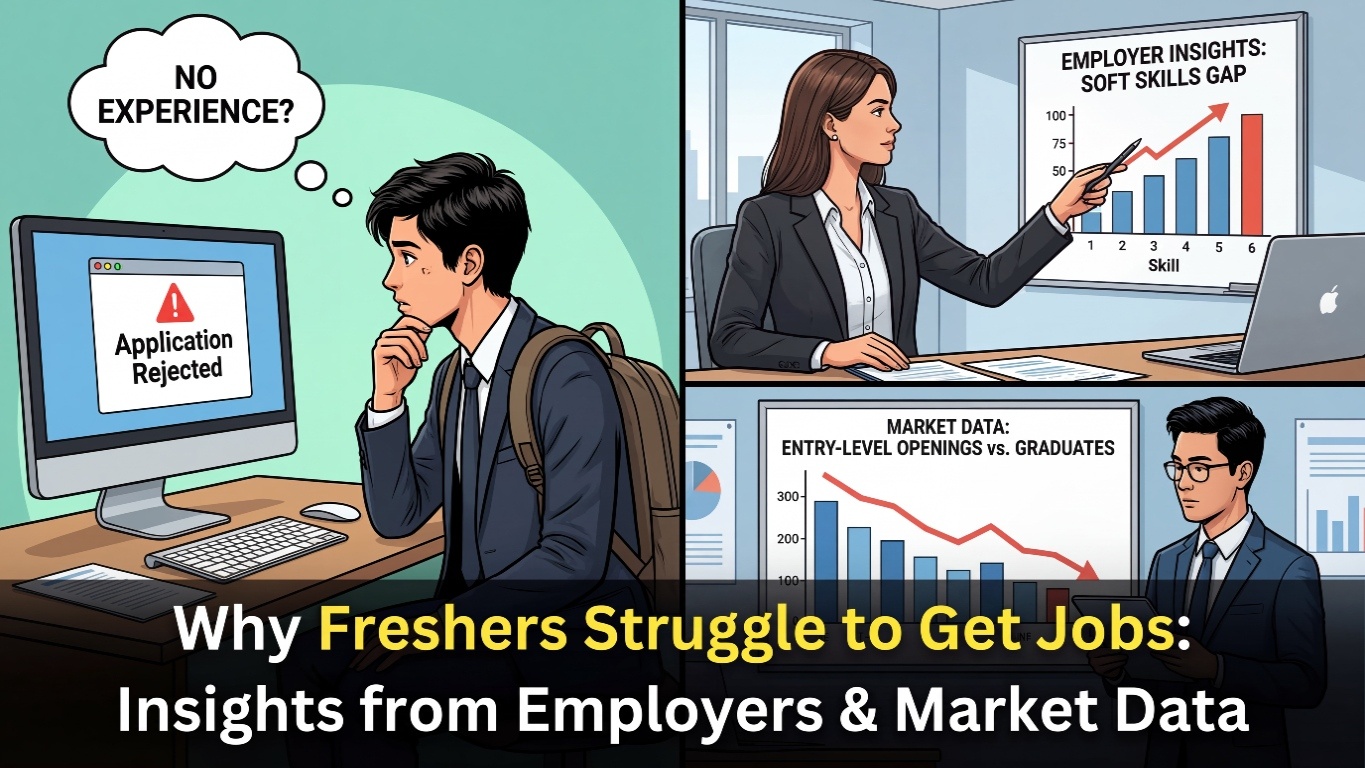
Landing your first job after graduation should feel like a victory lap, right? You've spent years studying, passed exams, and earned that degree. But for many fresh graduates today, the reality is far more challenging. Job applications go unanswered, interviews feel like interrogations, and the "entry-level" positions you find require 2-3 years of experience (wait, what?).
If you're a fresher struggling to land that first job, you're not alone. Let's dive deep into why this is happening, what employers are actually looking for, and most importantly, what you can do about it.
The job market for fresh graduates has become increasingly competitive. According to recent industry reports, the unemployment rate among recent college graduates remains significantly higher than experienced professionals. The gap between academic preparation and industry expectations has widened, leaving many qualified graduates on the sidelines.
Here's the frustrating catch-22 that every fresher knows too well: entry-level jobs demand experience, but how do you get experience without getting that first job? This circular problem has become the defining challenge of early career job hunting.
What You Learned vs. What They Need
Most college curricula focus heavily on theoretical knowledge. You might have aced your data structures exam, but employers want to know if you can build a functional application. You studied marketing principles, but can you create an actual social media campaign that drives results?
Employers consistently report that fresh graduates often lack:
The Technology Gap
The tech industry moves fast, sometimes faster than university syllabi can keep up. By the time a technology makes it into your coursework, it might already be outdated in the industry. Employers need people who can hit the ground running with current technologies and frameworks.
Beyond Technical Knowledge
Here's something that surprises many freshers: employers often reject candidates not because of weak technical skills, but due to poor communication abilities. In employer surveys, communication skills consistently rank as one of the top requirements, yet one of the most common gaps.
What employers need:
Teamwork and Collaboration
Most college projects involve working with friends or assigned groups. Real workplace collaboration is different. You'll work with people across departments, time zones, and sometimes difficult personalities. Employers want to see that you can navigate these dynamics.
The Expectation vs. Reality Gap
Many freshers enter the job market with salary expectations influenced by social media success stories, outlier cases, or incomplete information. When a graduate expects ₹8-10 lakhs for a role that typically pays ₹3-4 lakhs for freshers, it creates an immediate disconnect.
Employers are willing to invest in freshers, but they need to see the value proposition. If you're asking for an experienced professional's salary without the skills or track record, hiring managers will simply move on to more realistic candidates.
Not Understanding the Business
Walking into an interview without researching the company, its products, competitors, or industry trends is a massive red flag for employers. It signals a lack of genuine interest and preparation.
Freshers often struggle with:
First Impressions Matter
Your resume might get you in the door, but your interview performance determines whether you get the job. Common mistakes freshers make:
Your Resume Looks Like Everyone Else's
Employers receive hundreds of applications for each position. If your resume looks identical to the other 200 resumes, why should they pick you?
Common resume mistakes:
The Internship Advantage
Students who completed meaningful internships have a significant advantage. They've already proven they can work in a professional environment, understand workplace norms, and contribute to real projects.
Freshers without internships, projects, or any hands-on experience face an uphill battle. Employers wonder: "If they had four years of college, why didn't they do anything practical?"
The Investment Factor
From an employer's perspective, hiring a fresher is a significant investment. They'll need to spend:
Small and medium businesses especially struggle with this investment, which is why many prefer experienced candidates who can contribute immediately.
Recent employer surveys reveal eye-opening statistics:
When asked what prevents them from hiring freshers, employers most frequently cite:
Students who successfully land jobs quickly typically share common characteristics:
They Have a Portfolio: Whether it's a GitHub repository, a design portfolio, or a blog showcasing their writing, they have tangible proof of their abilities.
They Network Actively: They attend industry events, connect with professionals on LinkedIn, and leverage alumni networks. Many jobs are filled through referrals before they're even posted publicly.
They're Continuous Learners: They don't wait for someone to teach them. They take online courses, earn certifications, and stay updated with industry trends.
They Start Small: They're willing to take internships, contract work, or positions slightly below their dream role to get their foot in the door.
Take Action Now:
Even Before Graduating:
Practice Deliberately:
Make Yours Different:
Preparation is Key:
Build Relationships:
Set Yourself Up for Success:
Demonstrate Growth Mindset:
When hiring freshers, employers aren't expecting you to know everything. What they're looking for is:
Potential over perfection: Can you learn quickly and grow into the role?
Cultural fit: Will you mesh well with the team and company values?
Problem-solving ability: Can you think critically and figure things out?
Work ethic: Are you willing to put in the effort and go the extra mile?
Adaptability: Can you handle feedback and adjust to changing priorities?
Every hiring manager is mentally calculating the return on investment. They're asking: "How long before this person becomes productive and adds value?" Your job is to convince them that you'll reach that point faster than other candidates.
Remember, your first job is a stepping stone, not your final destination. Its primary purpose is to:
Don't hold out for the "perfect" first job so long that you miss opportunities to start building experience.
Employers care much less about which company hired you first than about what you learned and accomplished there. After 2-3 years, you'll have:
The tech industry is paradoxically one of the easiest and hardest for freshers. While there's high demand, there's also high competition and rapidly evolving skill requirements. Focus on building a strong GitHub portfolio and contributing to open source.
These fields often emphasize results and metrics. Create case studies from your internships or personal projects showing how your efforts drove specific outcomes.
These industries highly value academic pedigree, analytical skills, and communication abilities. Certifications like CFA Level 1 or advanced Excel skills can set you apart.
Your portfolio is everything. Invest time in building a diverse, high-quality portfolio that showcases your range and style. Network heavily in creative communities.
Job hunting as a fresher can be emotionally draining. You'll face many rejections before landing that first role. This is normal and doesn't reflect your worth as a person.
Healthy Coping Strategies:
Don't:
Do:
The workplace is changing rapidly with AI, automation, and remote work becoming standard. The freshers who will thrive are those who:
Some of the most in-demand jobs 10 years from now might not exist today. Focus on developing:
The challenges freshers face in the job market are real, but they're not insurmountable. Thousands of graduates just like you land their first job every single day. The difference between those who succeed quickly and those who struggle isn't usually talent or intelligence—it's preparation, persistence, and perspective.
Understanding why employers hesitate to hire freshers gives you power. You can address these concerns head-on, showing that you're the exception to the rule. You can demonstrate that you've already bridged the gaps that make other freshers risky hires.
1. Skills matter more than degrees: Invest in building practical, demonstrable skills
2. Communication is critical: Practice until you can articulate your value clearly
3. Experience comes in many forms: Internships, projects, freelancing, volunteering—it all counts
4. Networking opens doors: Many jobs are filled through connections before they're publicly advertised
5. Persistence pays off: The job search is a numbers game combined with continuous improvement
6. Be realistic but ambitious: Start somewhere, excel there, then level up
7. Your attitude matters: Employers can teach skills, but they can't teach attitude
Your college degree opened the door to opportunities, but it's your initiative, skills, and persistence that will actually land you the job. The market doesn't owe you a position just because you graduated, but it absolutely has a place for someone who's prepared, passionate, and professional.
The job market for freshers is challenging, but it's far from hopeless. Start taking action today, stay consistent, and remember that your first job is just the beginning of a long career journey.
Your future employer is out there right now, looking for someone exactly like you. Make sure that when they find your application, you stand out for all the right reasons.
Now stop reading and start doing. Your career is waiting.