1. Overview: The Modern Student's Dilemma 🤯
Remember when career advice was simple? Your parents or teachers would say: "Pick Science if you want to be a doctor or engineer, Commerce for banking, and Arts for everything else."
Those days are gone.
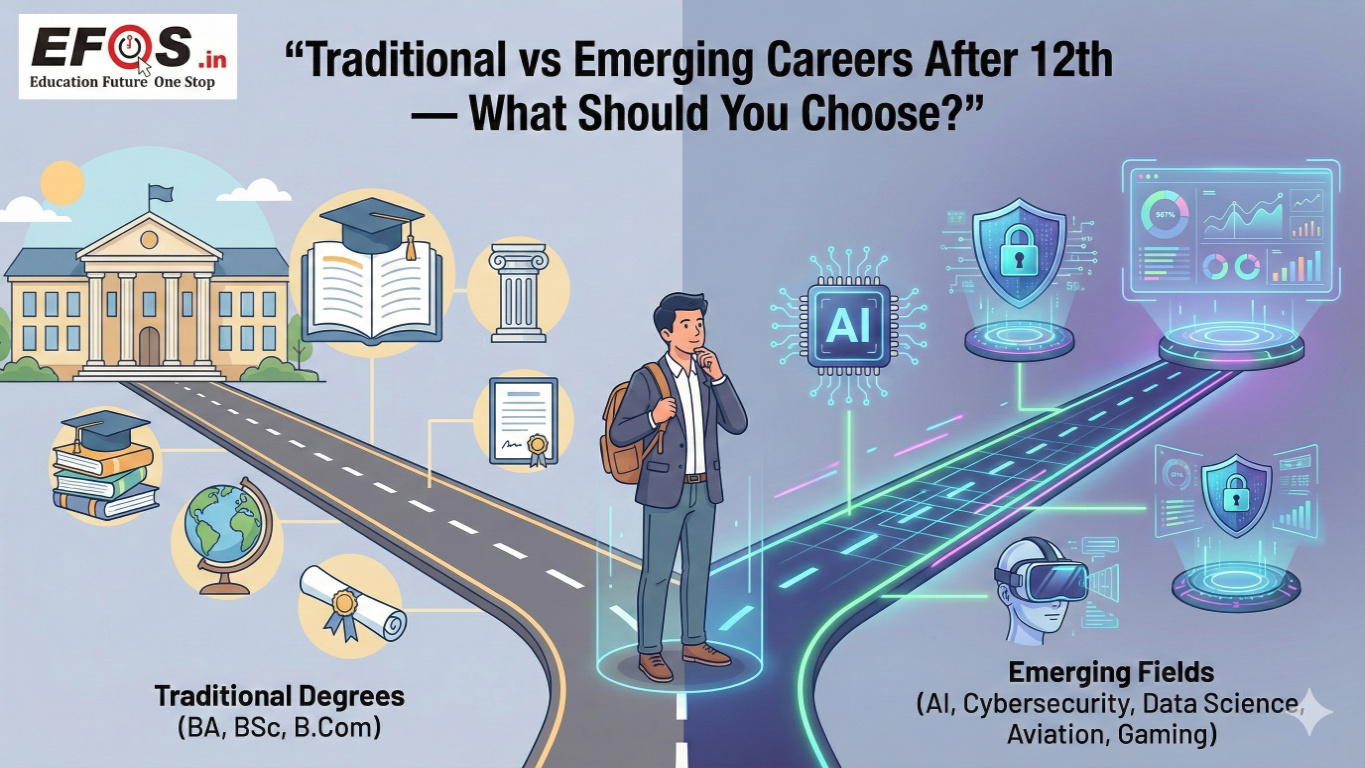
Today, you are standing at a massive crossroads. On one side, you have the Traditional Degrees (the "OGs" like BA, BSc, B.Com) that have built careers for decades. On the other side, you have exploding Emerging Fields (like Artificial Intelligence, Cybersecurity, Data Science, Aviation, Gaming) that promise high salaries and instant jobs.
It’s overwhelming. Are traditional degrees becoming useless? Are modern options just a hype bubble?
This blog isn't here to tell you what to pick. It’s here to give you the honest facts so you can decide what fits your personality and goals. Let’s dive in.
2. Traditional Degrees (The Classics: BA, BSc, B.Com) 🏛️
Let’s get one myth out of the way first: Traditional degrees are NOT dead.
These degrees (Bachelor of Arts, Science, or Commerce) are foundational. They don't just teach you facts; they teach you how to think, research, communicate, and analyze.
What they actually offer today:
- Flexibility & Breadth: A BA in Sociology doesn't mean you have to become a sociologist. It opens doors to HR, marketing, journalism, social work, and public policy. You aren't boxed into one tiny career path at age 20.
- The Ultimate Stepping Stone: If your goal is a high-level MBA, going into Law, or cracking the UPSC (civil services), these traditional degrees are often the best foundation.
- Soft Skills Supremacy: While tech changes every six months, human skills don't. These degrees heavily emphasize communication, critical thinking, and adaptability—skills that AI finds very hard to replicate.
The Catch: A traditional degree alone often isn't enough anymore. You usually need to add a Master's degree or specialized certifications atop a BA/BSc/B.Com to become truly job-ready in the corporate world.
3. Emerging Fields (The New Kids: AI, Cyber, Aviation, etc.) 🚀
These are the buzzwords you see everywhere. They are exciting, fast-paced, and usually linked directly to specific technology or industries.
Examples: AI & Machine Learning, Cybersecurity, Data Science, Aviation/Pilot training, Digital Marketing, Game Design.
What they actually offer today:
- Specific Skill Sets: You don't learn "broad concepts"; you learn exactly how to do a job. If you study Cybersecurity, you learn how to stop hackers. You graduate "job-ready."
- High Initial Demand & Pay: Right now, the world is desperate for AI specialists and cyber defenders. Starting salaries in these fields often beat traditional entry-level jobs by a significant margin.
- A Fast Track: These programs are often shorter and more intense, focused entirely on practical application rather than theory.
The Catch: The "shelf life" of tech knowledge is short. What you learn in AI today might be outdated in five years. You commit to a lifetime of constant upskilling just to stay relevant. Also, if you realize halfway through that you hate coding, switching careers is harder because your degree is hyper-specialized.
4. Which Suits Whom? Finding Your Fit 🧩
This is the most important part. Forget what your relatives say. Who are you?
Team Traditional (BA/BSc/B.Com) might be for you if:
- ✅ You aren't 100% sure what career you want yet and want to keep your options open.
- ✅ You love exploring big ideas, reading, writing, and understanding human behavior or theoretical science.
- ✅ You plan on pursuing higher education later (MBA, MA, MSc, Law School).
- ✅ You want to aim for government jobs, civil services, or academia.
- The Ideal Student: The "Explorer" or the "Academic."
Team Emerging (AI/Cyber/Aviation) might be for you if:
- ✅ You know exactly what you want to do (e.g., "I want to code AI bots" or "I want to fly planes").
- ✅ You prefer practical tasks over writing long essays or studying theory.
- ✅ You are comfortable with math, logic, and rapidly changing technology.
- ✅ You want a high-paying job immediately after graduation and desire financial independence quickly.
- The Ideal Student: The "Builder" or the "Specialist."
5. Future Demand: The Verdict 🔮
So, what actually works in the long run?
The future isn't about choosing one or the other. The future belongs to the "Hybrids."
- The Tech Demand is Real: Fields like AI, Cyber, and Green Energy will continue to explode. If you have these skills, you will be employed.
- The Human Element Returns: As AI takes over repetitive coding and data tasks, the demand for "human" skills (leadership, empathy, complex negotiation, ethics) will skyrocket. These are the skills traditional degrees teach best.
The Winning Strategy:
The best career path today is often a mix.
- Take a B.Com, but get a certification in Data Analytics so you can read financial numbers better than anyone else.
- Take a BA in Psychology, but learn UX Design, making you invaluable to tech companies building apps.
- Do a BSc in Computer Science, but take electives in Philosophy or Ethics so you can lead AI teams responsibly.
Final thought for students: Don't make a decision out of fear of missing out (FOMO). A traditional degree is a solid foundation; a modern option is a specialized rocket ship. Both can get you to the moon—they just use different fuel. Choose the engine that fits you best. Good luck! 🎓🚀