Hey students! Exams can feel like a marathon where you need both stamina and speed. The good news? You don't have to cram endlessly. Smart study techniques can supercharge your memory, help you recall facts faster, and boost your speed without burnout. In this post, we'll break down the top proven methods—backed by science and real student wins—to get you exam-ready.
Strong memory means pulling answers from your brain instantly, not fumbling through notes. Speed lets you finish papers quickly, leaving time to double-check. Together, they turn average scores into top marks. Studies from psychologists like those at Harvard show active techniques beat passive reading by up to 50%. Ready to level up?
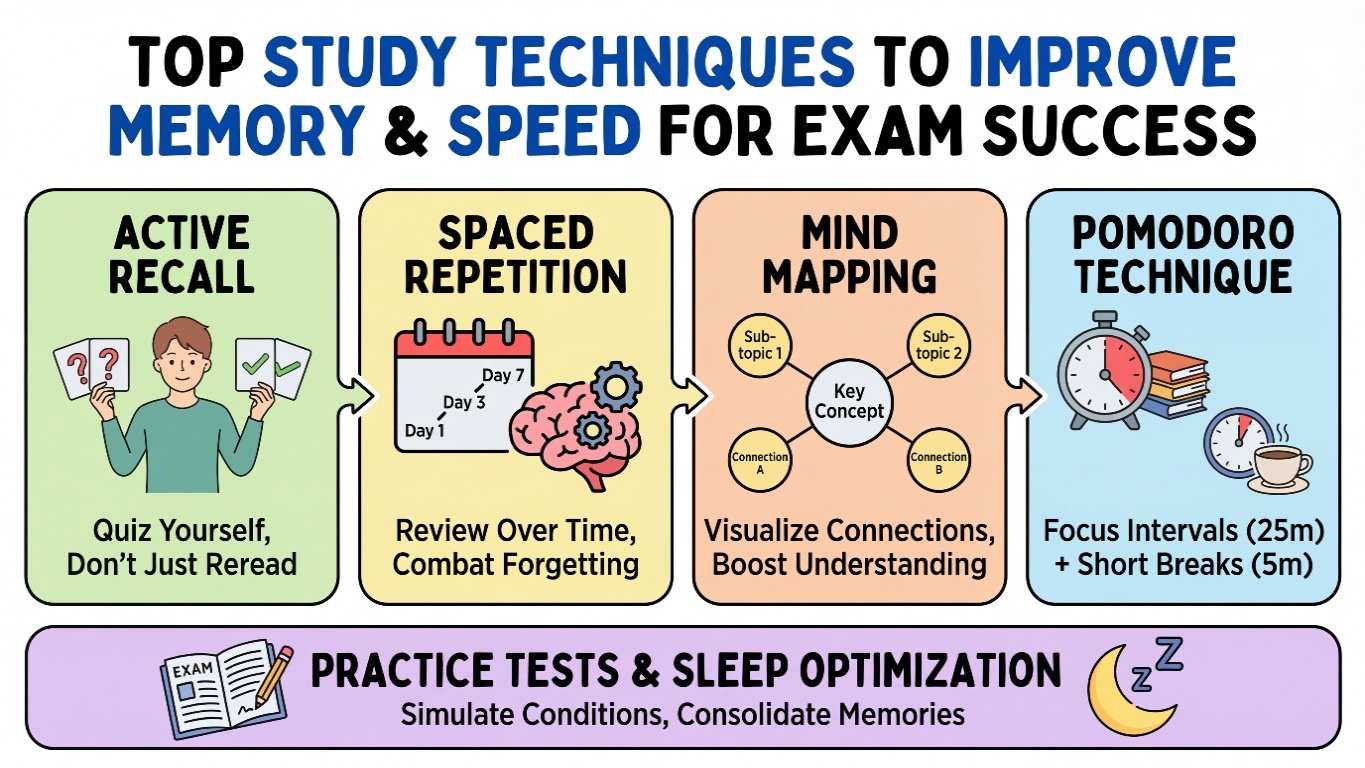
Active recall is like quizzing yourself instead of re-reading notes. It forces your brain to retrieve info, strengthening memory pathways.
Pro Tip: Start sessions with 10 minutes of recall. Students report 2x faster recall after a week.
Cramming fades fast, but spaced repetition spaces out reviews—like watering a plant just right. Apps schedule reviews based on how well you know the material.
Real Result: One study in Psychological Science found it improves long-term retention by 200%. Perfect for piling up facts without overload.
Named after physicist Richard Feynman, this method makes you simplify complex ideas. If you can't explain it like you're 10, you don't get it yet.
Why It Works for Speed: Simplifying cuts study time and makes answers flow during exams.
Pomodoro is 25 minutes focused study + 5-minute break. Add a speed twist: time yourself to cover more ground each session.
Student Hack: Track your pages-per-Pomodoro. You'll hit peak speed in days.
Ditch linear notes. Mind maps link ideas visually, like a brain's natural web, speeding up connections.
Example: For history, center "World War II," branch "Causes," "Leaders," "Events." Recall jumps because visuals stick.
Mnemonics turn boring lists into stories. Chunking groups info into bite-sized pieces (our brains love 7±2 items).
Speed Boost: These cut memorization time by 30-50%, per memory experts.
Mix them! Use mind maps for planning, active recall for testing, and Pomodoro for practice papers. Simulate exam conditions weekly—timed, no distractions.
These techniques aren't magic—they're science-backed tools any student can use. Start small, track progress, and watch your memory and speed soar. You've got this! Share your fave technique in the comments—what's worked for you?
Drop a like if this helped, and subscribe for more study tips. Next up: beating procrastination!