
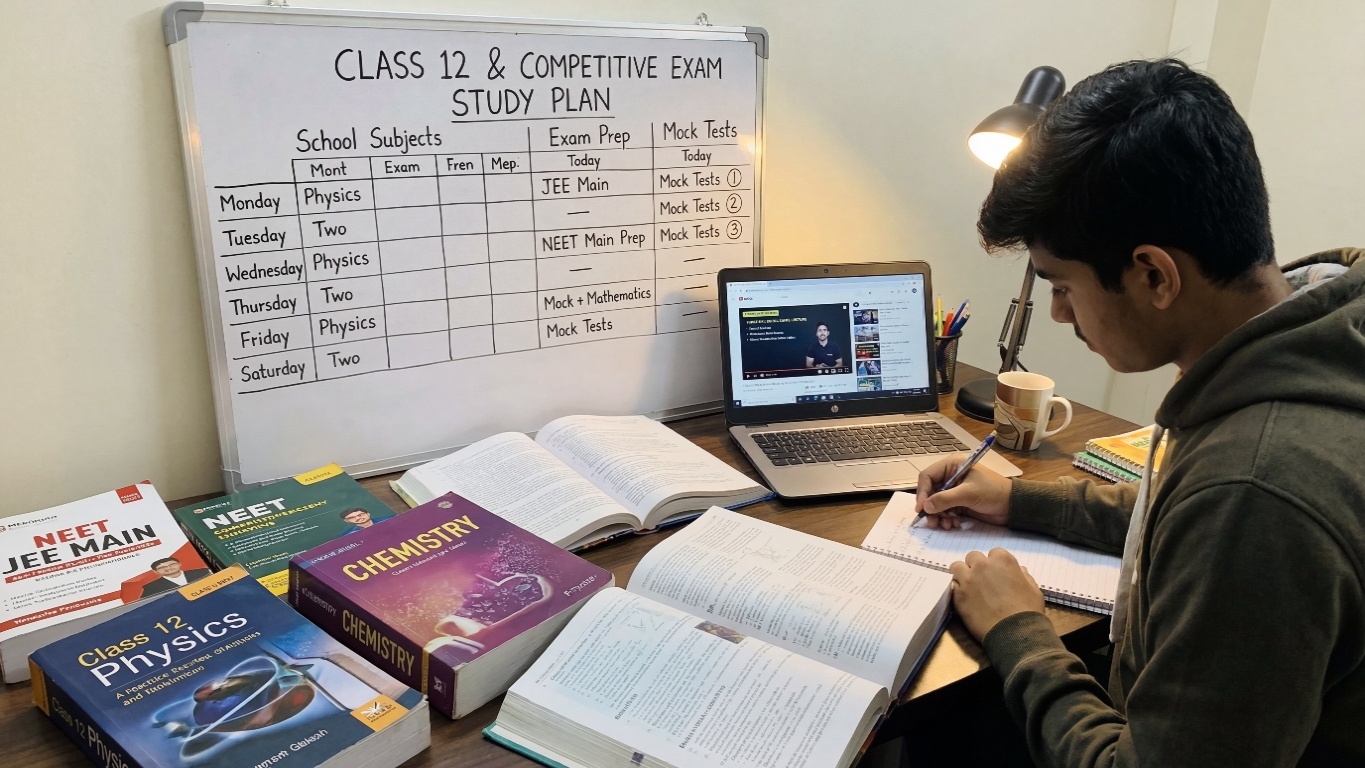
Class 12 is arguably one of the most challenging years for students in India. You're juggling board exam preparation while simultaneously working toward competitive exams like JEE, NEET, CLAT, or other entrance tests. The pressure can feel overwhelming, but with the right strategy and mindset, you can excel at both without burning out.
This comprehensive guide will help you create a balanced study plan that covers both your board exams and competitive exam preparation effectively.
Before diving into strategies, let's acknowledge what you're dealing with. Class 12 brings together multiple pressures: board exam expectations from parents and teachers, competitive exam preparation for your dream college, maintaining a social life, and dealing with anxiety about your future. It's a lot, and it's completely normal to feel stressed.
The good news? Both board exams and competitive exams have significant syllabus overlap, especially for science students. With smart planning, you can prepare for both simultaneously without doubling your workload.
Start by getting crystal clear about your objectives. Ask yourself:
Write down your goals and paste them somewhere visible. This clarity will guide every decision you make about how to spend your study time.
Here's a framework that works for most students: dedicate 70% of your study time to competitive exam preparation and 30% to board-specific content. Why? Because competitive exam preparation is more challenging and covers most of your board syllabus anyway, just at a deeper level.
If you're preparing for JEE or NEET, solving those tough problems will automatically make board questions feel easier. You'll just need some extra time closer to board exams for theory, definitions, and board-specific question patterns.
Break down your year into distinct phases:
April to July (Foundation Phase)
August to October (Building Phase)
November to December (Board Focus Phase)
January to February (Board Exam Mode)
March to April (Final Sprint for Competitive Exams)
Here's a sample daily schedule that you can customize based on your school timings and personal preferences:
Morning Routine (Before School)
After School
Key Points About This Schedule:
Physics
Chemistry
Mathematics/Biology
If you're preparing for CLAT, CA Foundation, or other entrance exams:
Study in focused 25-minute blocks followed by 5-minute breaks. After four blocks, take a longer 15-20 minute break. This prevents mental fatigue and improves retention.
Don't just read your notes passively. Close your book and try to recall what you just studied. Review topics at increasing intervals: after 1 day, 3 days, 1 week, 2 weeks, 1 month.
If you can't explain a concept to a friend in simple terms, you don't understand it well enough. Teaching is one of the best ways to learn.
For competitive exams, solving problems matters more than reading theory. Aim to solve at least 50-100 problems per subject per week once you've covered the basics.
Mock tests are your reality check. Here's how to use them effectively:
Taking Mock Tests:
Analyzing Mock Tests: This is where the real learning happens. Spend as much time analyzing a mock test as you spent taking it.
Most of your Class 11 and 12 syllabus appears in competitive exams. When you study for JEE or NEET, you're automatically preparing for boards too. The difference is mainly in the difficulty level and question pattern.
For NEET especially, and even for JEE, NCERT textbooks are golden. Read them thoroughly, including examples and exercises. Many competitive exam questions come directly from NCERT or are variations of NCERT problems.
Start board-specific preparation seriously from December. Focus on:
Your board percentage matters for admissions in many colleges. Allocate 30-45 minutes daily to languages and other subjects. These are usually scoring subjects where you can secure easy marks.
Watch out for: constant fatigue, loss of interest in studies, irritability, sleep problems, or physical symptoms like headaches. If you notice these, take action immediately.
Physical Health:
Mental Health:
Social Balance: You don't need to become a hermit. Meet friends occasionally, attend important family functions, and take short breaks. A refreshed mind studies better than an exhausted one.
Let's be honest—social media is addictive and destructive to your focus. Here's how to manage it:
For JEE:
For NEET:
For CLAT:
More books don't mean better preparation. Stick to 2-3 quality books per subject and master them completely rather than collecting dozens of books you'll never finish.
One bad test doesn't define you. Analyze what went wrong, learn from it, and move forward. Every topper has had bad days.
Life happens. If you fall behind, don't try to catch up by pulling all-nighters. Adjust your schedule realistically and focus on high-priority topics.
Break your goals into smaller, achievable tasks. Instead of "complete Physics," aim for "finish 5 problems from rotational motion." Small wins build momentum.
Your classmate might be scoring higher or studying longer. So what? Focus on your own journey, your own progress. Success is personal, not relative.
Class 12 with competitive exam preparation is tough, but thousands of students successfully navigate it every year. You're not alone in this journey. Here's what you need to remember:
It's a marathon, not a sprint. Consistency beats intensity. Studying 6 hours daily for 10 months is far better than studying 12 hours daily for 3 months and burning out.
Your worth isn't defined by exam results. Yes, these exams are important, but they're not everything. You are more than your rank or percentage.
Taking breaks isn't laziness. Rest is productive. Your brain needs time to consolidate information.
Ask for help when needed. Whether it's academic doubts, emotional support, or just someone to talk to, don't hesitate to reach out to teachers, parents, friends, or counselors.
Celebrate small victories. Finished a chapter? Solved a tough problem? Improved your mock test score? Acknowledge and celebrate these wins.
Don't wait for the "perfect time" to start. Begin tomorrow with these simple steps:
Preparing for competitive exams alongside Class 12 boards is challenging, but it's absolutely doable with the right approach. Remember that this is temporary—the intensity won't last forever. Give it your best shot, but also be kind to yourself.
Success isn't just about cracking the exam; it's about growing as a person, building resilience, learning time management, and discovering your capabilities. These skills will serve you well beyond any entrance test.
You've got this. Stay focused, stay balanced, and trust the process. Your future self will thank you for the effort you're putting in today.
All the best for your exams! You're going to do great things.