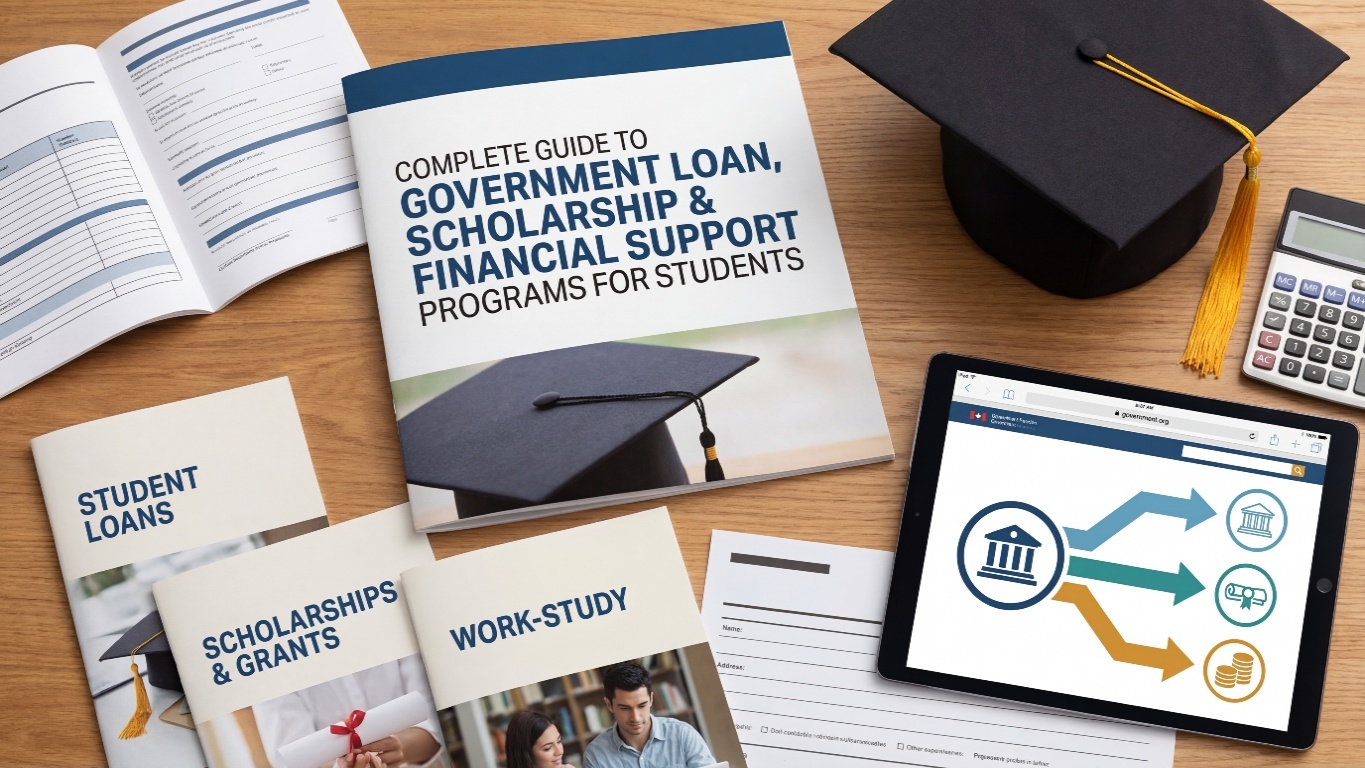
Money shouldn't be the reason you can't pursue your dreams. Whether you're aiming for engineering, medicine, arts, or any other field, there are numerous government schemes designed specifically to help students like you. This guide breaks down everything you need to know about loans, scholarships, and financial support available in India.
Understanding the Basics: What's Available?
Before we dive deep, let's understand the three main types of financial support:
Government Loans - Money you borrow and pay back after completing your studies, usually with lower interest rates than regular bank loans.
Scholarships - Free money you don't have to pay back, awarded based on merit, need, or specific criteria.
Financial Support Programs - Various schemes including fee waivers, stipends, and other assistance that help reduce your education costs.
Education Loans: Your Gateway to Higher Studies
What is an Education Loan?
An education loan covers your tuition fees, hostel charges, books, equipment, and sometimes even travel expenses for studying in India or abroad. The best part? You start repaying only after you complete your course and find a job.
Central Government Education Loan Schemes
1. Central Sector Interest Subsidy Scheme (CSIS)
This scheme is a game-changer for students from economically weaker sections.
Who can apply?
- Students whose family income is less than ₹4.5 lakh per year
- Those who have secured admission to recognized institutions in India through entrance exams
Key benefits:
- Complete interest subsidy during your study period
- The government pays the interest while you're studying
- Applies to loans taken from scheduled banks under the IBA model scheme
How to apply: Apply through your bank when taking an education loan, and they'll help you with the CSIS application.
2. Padho Pardesh Scheme
Dreaming of studying abroad? This scheme helps students from minority communities.
Eligibility:
- Students from six notified minority communities
- Family income below ₹6 lakh per year
- Secured admission in top-ranked foreign universities
Coverage:
- Interest subsidy on education loans up to ₹20 lakh
- Covers tuition fees, living expenses, and travel costs
How to Get an Education Loan: Step by Step
Step 1: Research Your Options Compare different banks and their interest rates. Public sector banks often have schemes tied to government subsidies.
Step 2: Check Eligibility Most banks require you to have admission confirmation and a co-applicant (usually a parent or guardian).
Step 3: Gather Documents
- Admission letter from the institution
- Mark sheets from previous exams
- Income proof of parents/guardians
- Identity and address proof
- Cost estimate from the institution
Step 4: Apply Visit the bank branch or apply online through their portal. Many banks now offer digital applications.
Step 5: Loan Approval The bank will verify your documents and assess your loan application. This usually takes 2-4 weeks.
Smart Tips for Education Loans
- Compare interest rates from at least 3-4 banks before deciding
- Understand the moratorium period - this is the time you don't have to repay (usually study period + 6 months to 1 year)
- Check for hidden charges like processing fees, prepayment charges, etc.
- Maintain good academic records - some banks offer interest discounts for high performers
Government Scholarships: Free Money for Your Education
Scholarships are incredibly valuable because you never have to pay them back. Here are the major government scholarship programs you should know about.
National-Level Scholarships
1. National Scholarship Portal (NSP)
The NSP is your one-stop destination for applying to multiple scholarships. Over 50 schemes from different ministries are available here.
Website: scholarships.gov.in
How it works:
- Create one profile on the portal
- Apply to multiple scholarships using the same profile
- Track all your applications in one place
2. Pre-Matric Scholarships
For students studying in classes 9 and 10.
Schemes under this:
- Pre-Matric Scholarship for SC/ST/OBC students
- Pre-Matric Scholarship for Minority communities
- Pre-Matric Scholarship for students with disabilities
Typical benefits:
- ₹1,000 to ₹7,000 per year depending on day scholar or hosteller
- Covers tuition fees, books, and stationery
3. Post-Matric Scholarships
For students studying in class 11 and above, including graduation and post-graduation.
Key schemes:
- Post-Matric Scholarship for SC Students - Up to ₹2,000 to ₹3,000 per month for college students
- Post-Matric Scholarship for OBC Students - Similar benefits for OBC category students
- Post-Matric Scholarship for Minority Students - For students from notified minority communities
What's covered:
- Tuition fees (actual amount or ceiling amount)
- Maintenance allowance for hostellers and day scholars
- Book allowance and other compulsory fees
4. Merit-Cum-Means Based Scholarships
Don't let the name intimidate you. This is for students who have good marks and come from families with limited income.
Eligibility:
- Family income below ₹6 lakh per year
- Admission to first year of professional or technical courses
- Minimum 50% marks in Class 12
Benefits:
- Up to ₹20,000 per year for degree courses
- Up to ₹10,000 per year for diploma courses
5. Central Sector Scheme of National Means-cum-Merit Scholarship (NMMSS)
Perfect for students in classes 9 to 12.
Who should apply:
- Students who scored at least 55% in class 8
- Family income less than ₹3.5 lakh per year
- Currently studying in class 9, 10, 11, or 12
Scholarship amount: ₹12,000 per year (₹1,000 per month)
6. PM YASASVI Scheme
A newer scheme for OBC, EBC, and DNT students in classes 9 and 11.
Benefits:
- ₹75,000 per year for class 9 and 10 students
- ₹1.25 lakh per year for class 11 and 12 students
Selection process: Through YET (YASASVI Entrance Test) conducted by NTA
State-Level Scholarships
Each state has its own scholarship schemes. Some popular ones include:
Maharashtra: EBC Scholarship, TFWS Scholarship Uttar Pradesh: Samajwadi Scholarship, UP Scholarship West Bengal: Swami Vivekananda Merit-cum-Means Scholarship, Kanyashree Prakalpa Tamil Nadu: Dr. Ambedkar Post-Matric Scholarship Karnataka: Fee Reimbursement Scheme
Pro tip: Check your state's official scholarship portal for complete details.
Scholarships for Higher Education
AICTE Scholarships
If you're pursuing engineering or technical education:
- Pragati Scholarship - For girl students in technical courses (₹50,000 per year)
- Saksham Scholarship - For differently-abled students in technical courses (₹50,000 per year)
UGC Scholarships
- Ishan Uday Scheme - For students from North-Eastern Region pursuing higher education
- Single Girl Child Scholarship - ₹3,000 per month for postgraduate students who are the only girl child
INSPIRE Scholarship
For students pursuing BSc/MSc in natural sciences.
Eligibility:
- Top 1% students in class 12 board exams
- Pursuing basic sciences
Benefits:
- ₹80,000 per year during BSc
- Assured opportunity for research internship
Special Category Support Programs
For Girl Students
Scholarships specifically for girls:
- Balika Samridhi Yojana
- CBSEUdaan Scheme for girl students preparing for engineering entrance
- National Scheme of Incentives to Girls for Secondary Education
- Begum Hazrat Mahal National Scholarship
Why these matter: These schemes aim to increase female participation in education, especially in STEM fields and higher education.
For SC/ST Students
Beyond general scholarships, special provisions include:
- National Fellowship for SC Students - For pursuing higher education (MPhil/PhD)
- Top Class Education Scheme - Full financial support for professional and technical courses
- Free Coaching Scheme - Free coaching for competitive exams
For Minority Communities
- Maulana Azad National Fellowship - For research scholars
- Post-Matric Scholarship for Minority Students
- Merit-cum-Means Scholarship for Professional and Technical Courses
For Persons with Disabilities
- National Fellowship for Students with Disabilities
- Scholarship for Students with Disabilities pursuing higher education
- Special fee concessions and exam assistance
For Economically Weaker Sections (EWS)
- EWS Scholarship - Available in most states for students from families with annual income below ₹8 lakh
- Fee waiver schemes in government colleges and universities
How to Successfully Apply for Scholarships
Creating a Strong Application
1. Start Early Most scholarship portals open applications for only 2-3 months. Mark your calendar and apply as soon as the portal opens.
2. Keep Documents Ready Common documents needed:
- Aadhaar card
- Income certificate (issued within the last 6 months)
- Caste certificate (if applicable)
- Admission receipt or bonafide certificate
- Bank account details (preferably in your name)
- Previous year's mark sheets
- Passport-sized photograph
3. Fill Forms Carefully One small mistake can lead to rejection. Double-check:
- Spelling of your name (should match Aadhaar)
- Date of birth
- Bank account number and IFSC code
- Mobile number and email
4. Track Your Application Save your application ID and password. Check the status regularly on the portal.
Common Mistakes to Avoid
- Missing deadlines - Set reminders on your phone
- Wrong category selection - Choose carefully between hosteller/day scholar
- Incomplete applications - Upload all required documents
- Wrong bank details - Verify account number multiple times
- Not renewing - Most scholarships need renewal every year
Financial Support Programs Beyond Loans and Scholarships
Mid-Day Meal Scheme
For students up to class 8 in government schools, providing nutritional support.
Free Textbooks and Uniforms
Many state governments provide free books and uniforms to students from economically weaker sections.
Fee Waiver Schemes
Several universities and colleges offer complete or partial fee waivers based on:
- Economic background
- Merit performance
- Reserved categories
Transportation Support
Some states provide:
- Free bus passes for girl students
- Bicycle schemes for rural students
- Travel allowance for students from remote areas
Hostel Facilities
Government hostels with subsidized or free accommodation for:
- SC/ST students
- Minority students
- Girl students
- Students from economically weaker sections
Creating Your Financial Aid Plan
Step 1: Assess Your Needs
Calculate your total education expenses:
- Tuition fees: ₹______
- Books and study materials: ₹______
- Accommodation (if applicable): ₹______
- Food and daily expenses: ₹______
- Transportation: ₹______
- Other expenses: ₹______
- Total: ₹______
Step 2: Identify Eligible Schemes
Make a list of all schemes you're eligible for based on:
- Your category (General/SC/ST/OBC/Minority)
- Family income
- Course and level of study
- Academic performance
- Gender
- State of residence
Step 3: Apply Strategically
Priority 1: Apply for scholarships first (free money!) Priority 2: Look for fee waivers and support programs Priority 3: Consider education loans if there's still a gap
Step 4: Keep Alternative Options Ready
Always have a backup plan. Apply to multiple scholarships and be prepared with loan applications if needed.
Frequently Asked Questions
Can I apply for multiple scholarships? Yes, but be careful. Some scholarships cannot be combined. Check the terms of each scheme.
What if my family income is slightly above the limit? Income limits are usually strictly enforced. However, merit-based scholarships may not have income restrictions.
Do I need to pay back scholarship money? No, scholarships are grants that don't need to be repaid unless you drop out or fail to meet continuation requirements.
What happens if I fail in an exam? Most scholarships require you to maintain minimum attendance and academic standards. Failure may lead to discontinuation.
Can I get both a scholarship and an education loan? Yes, you can use a scholarship to cover partial expenses and take a loan for the remaining amount.
How long does it take to receive scholarship money? After approval, it usually takes 1-3 months for the money to be credited to your account. Some delays may occur.
What if my caste/income certificate is expired? Get it renewed immediately. Most certificates are valid for only 6 months to 1 year.
Resources and Important Links
National Portals
- National Scholarship Portal: scholarships.gov.in
- Vidyalakshmi Portal (Education Loans): vidyalakshmi.co.in
- UGC Scholarships: ugc.ac.in
- AICTE Scholarships: facilities.aicte-india.org
Ministry Websites
- Ministry of Social Justice and Empowerment: socialjustice.gov.in
- Ministry of Minority Affairs: minorityaffairs.gov.in
- Ministry of Tribal Affairs: tribal.nic.in
- Ministry of Education: education.gov.in
Help and Support
- NSP Helpdesk: helpdesk@nsp.gov.in
- Toll-Free Number: 0120-6619540
- Vidyalakshmi Helpline: 1800-425-4445
Final Words of Encouragement
Remember, financial constraints are temporary roadblocks, not dead ends. Thousands of students like you overcome these challenges every year through government support schemes. The key is to:
- Stay informed about available schemes
- Apply on time - don't miss deadlines
- Keep documents ready throughout the year
- Follow up on your applications
- Never give up - if one scheme doesn't work, try another
Your education is an investment in your future. The government has created these schemes specifically to ensure that no deserving student is left behind due to financial issues. Take advantage of them, work hard, and build the future you deserve.
Good luck with your applications, and may your educational journey be smooth and successful!