
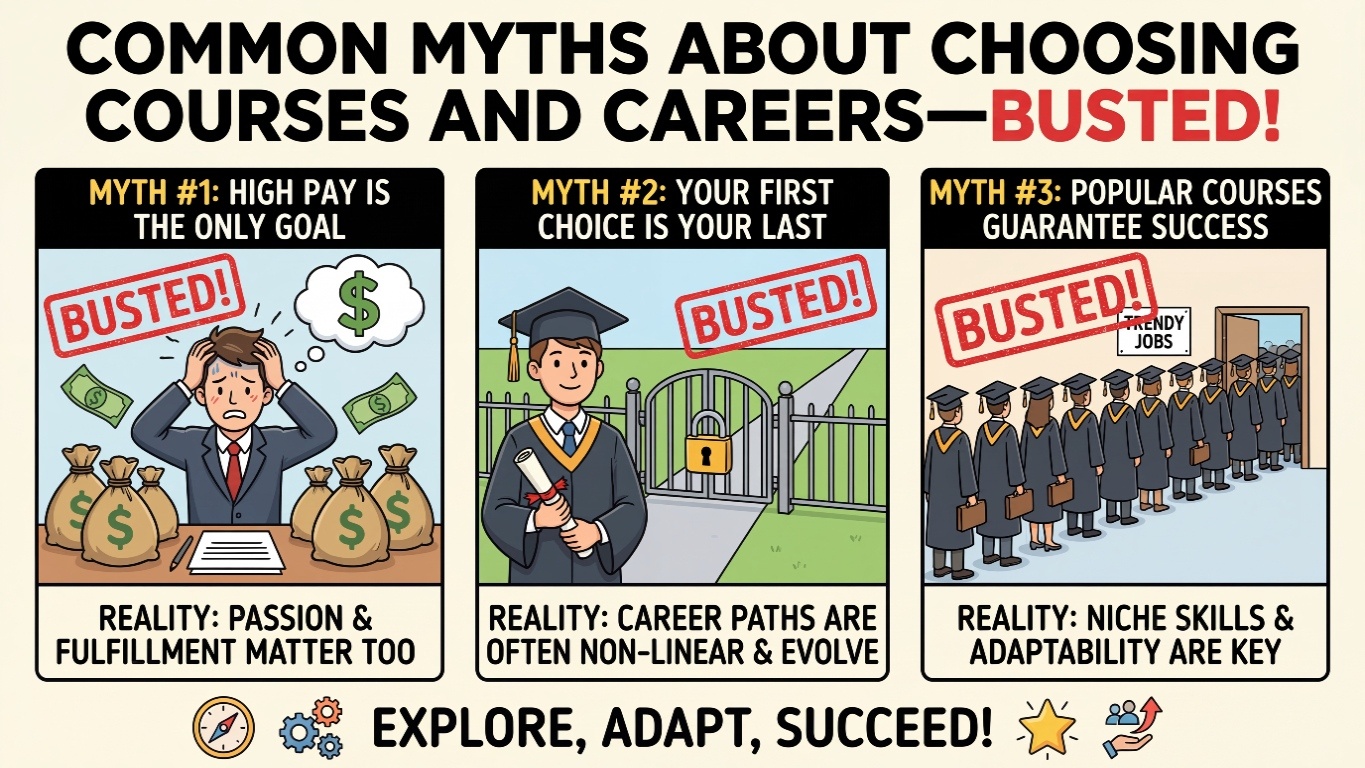
Choosing a course or career path is one of the biggest decisions you'll make as a student. But let's be honest—there's a lot of confusing advice floating around, and it's hard to know what's actually true. You've probably heard things like "follow your passion" or "engineering is the only safe career," and maybe you're wondering if these statements hold up in the real world.
Spoiler alert: they don't always! In this blog, we're going to break down some of the most common myths about choosing courses and careers, and give you the real deal. Let's bust these myths wide open so you can make informed decisions about your future.
One of the biggest pressures students face is feeling like they need to know exactly what they want to do for the rest of their lives before they even graduate high school. But here's the reality: most people change careers multiple times throughout their lives. According to various studies, the average person switches careers five to seven times during their working years.
Your first choice doesn't lock you into a single path forever. Many successful people started in one field and pivoted to something completely different. The key is to choose something that interests you now and stay open to learning and growing along the way.
Focus on building transferable skills like communication, problem-solving, critical thinking, and adaptability. These skills will serve you well no matter where your career takes you. Also, remember that exploring different interests through internships, projects, and electives is perfectly okay—it's part of the journey!
We've all heard the romanticized version of career advice: "Do what you love, and you'll never work a day in your life." While there's some truth to finding fulfillment in your work, this myth oversimplifies things. Passion alone doesn't always translate to a sustainable career, especially if the field you're passionate about has limited job opportunities or doesn't align with market demands.
The reality is that successful careers are built at the intersection of passion, skills, and market demand. You need all three to create a fulfilling and financially stable career.
Instead of only following your passion, ask yourself: What am I good at? What does the world need? What can I get paid for? Finding the sweet spot where these three questions overlap will lead you to a more balanced and realistic career choice. It's okay to have hobbies you're passionate about that aren't your main source of income!
There's a common belief that if you're not pursuing Science, Technology, Engineering, or Mathematics (STEM), you won't have a secure or high-paying career. While STEM fields do offer great opportunities, they're far from the only option for success.
Careers in business, healthcare, creative industries, law, education, and trades can be equally rewarding and lucrative. The demand for skilled professionals exists across all sectors. For example, digital marketing specialists, content creators, therapists, skilled electricians, and financial advisors are all in high demand and can earn excellent salaries.
Research careers based on your interests and strengths, not just on what others say is "safe." Look at job market trends, salary data, and growth projections across various industries. You might be surprised to find high-demand careers in fields you hadn't considered.
While attending a well-known university can open doors, it's not the only factor that determines your success. Employers increasingly value skills, experience, and what you can actually do over where you studied. Many successful entrepreneurs, artists, and professionals didn't attend Ivy League schools—some didn't even finish college.
What matters more is how you use your time in college: the skills you develop, the connections you make, the projects you work on, and the internships you complete.
Focus on getting the best education you can afford while also building practical experience. Look for programs that offer hands-on learning, industry connections, and opportunities for internships. Sometimes a lesser-known university with strong industry ties in your field can be more valuable than a prestigious name with less practical focus.
Family pressure is real, and many students feel obligated to pursue careers their parents approve of—often traditional options like medicine, engineering, or law. While your parents likely have your best interests at heart, they may not fully understand modern career options or what truly motivates you.
Choosing a career solely to please others can lead to burnout, dissatisfaction, and regret down the line. Your career is something you'll spend a significant portion of your life doing, so it needs to align with your own values, interests, and goals.
Have an open, honest conversation with your parents about your interests and career goals. Come prepared with research about the career paths you're interested in, including job prospects, growth potential, and earning potential. Often, parents just want to know you'll be secure and successful—showing them you've done your homework can help ease their concerns.
There's a stigma around gap years, with many people believing that taking time off between high school and college (or during college) means you're lazy or directionless. In reality, a well-planned gap year can be incredibly valuable.
During this time, you can gain work experience, volunteer, travel, learn new skills, or simply figure out what you really want to study. Many students return from gap years with greater clarity, maturity, and motivation, which often leads to better academic performance and career outcomes.
If you're considering a gap year, make it purposeful. Set clear goals for what you want to achieve during this time. Whether it's working to save money, gaining industry experience through internships, learning a new language, or exploring potential career paths, a structured gap year can be a smart investment in your future.
Many students stress about choosing the "right" major because they think it will lock them into a specific career path. But here's something interesting: studies show that a significant percentage of graduates work in fields unrelated to their college major.
Your major provides foundational knowledge and skills, but it doesn't define your entire career trajectory. Many employers care more about your abilities, work ethic, and relevant experience than the specific subject you studied.
Choose a major that genuinely interests you and helps you develop valuable skills. If you're worried about job prospects, consider double majoring, adding a minor, or taking electives in practical areas. Also, focus on building relevant experience through internships, projects, and extracurricular activities—these often matter more than your major when job hunting.
It's frustrating when entry-level job postings ask for years of experience, but don't let this discourage you. This is often a "wish list" rather than a strict requirement. Many employers are willing to train motivated candidates who show potential, even if they don't meet every qualification.
Additionally, experience comes in many forms. Internships, volunteer work, freelance projects, academic research, and even relevant coursework can count as valuable experience.
Apply for positions even if you don't meet 100% of the requirements—aim for about 60-70% qualification. Highlight transferable skills from school projects, extracurricular activities, part-time jobs, or volunteer work. Focus on demonstrating enthusiasm, willingness to learn, and how your unique background can bring value to the role.
There's a misconception that hard skills (like coding, data analysis, or accounting) are all that matter for career success. While technical skills are important, soft skills—communication, teamwork, emotional intelligence, adaptability, and problem-solving—are equally crucial.
In fact, many employers report that they can teach technical skills, but soft skills are harder to develop. As you advance in your career, soft skills often become even more important, especially in leadership roles.
Develop both! While you're learning technical skills relevant to your field, also work on your communication abilities, leadership qualities, and interpersonal skills. Join clubs, take on group projects, participate in presentations, and seek opportunities that challenge you to work with diverse teams.
Setbacks, rejections, and failures are normal parts of any career journey. Getting rejected from your dream college, not landing the internship you wanted, or struggling in a particular course doesn't mean you've made the wrong choice or that you're not cut out for your chosen field.
Every successful person has faced failures. What sets them apart is resilience—the ability to learn from setbacks, adapt, and keep moving forward.
Reframe failure as feedback. When things don't go as planned, ask yourself what you can learn from the experience. Develop resilience by setting small, achievable goals and celebrating your progress. Surround yourself with supportive people who encourage your growth, and remember that your career is a marathon, not a sprint.
Choosing courses and careers can feel overwhelming, especially with all the conflicting advice out there. But here's the bottom line: there's no single "right" path, and you don't need to have everything figured out immediately.
Focus on:
Your career journey is uniquely yours. By busting these common myths and approaching your decisions with curiosity, flexibility, and self-awareness, you'll be well-equipped to create a fulfilling career path—whatever that looks like for you.
Remember, it's okay to change your mind, pivot, and grow. The most successful careers aren't built on following rigid rules but on continuous learning, adaptation, and staying true to what matters to you.
What myths have you heard about choosing courses or careers? Share your thoughts in the comments below!