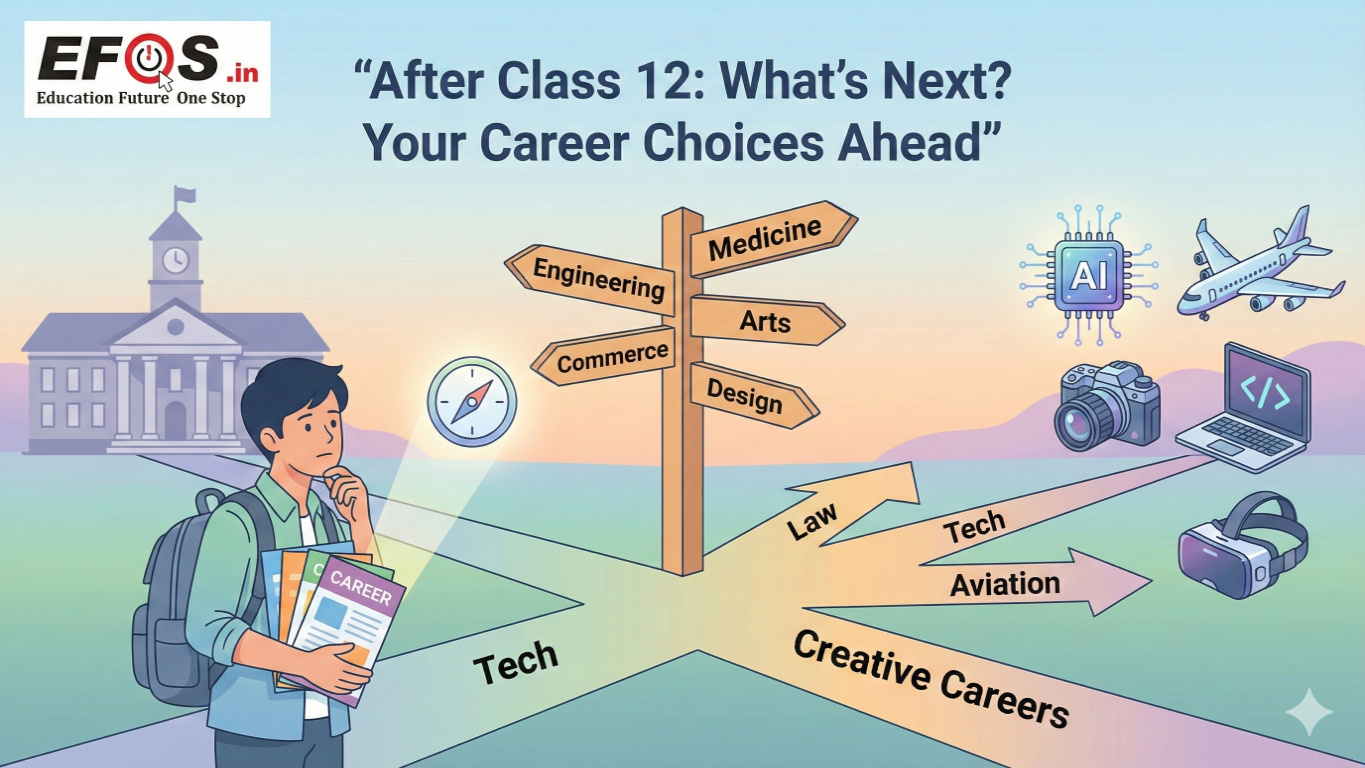
Completing Class 12 is a significant milestone, but it often comes with a daunting question: "What's next?" The pressure to choose the "right" career path can feel overwhelming, especially when everyone around you seems to have an opinion. Whether you're drawn to engineering, medicine, arts, commerce, or something entirely unconventional, this guide will help you navigate your options with clarity and confidence.
Before diving into career options, take a moment to understand yourself. Your career choice should align with your interests, strengths, and values—not just what's trending or what others expect.
Ask yourself these questions:
Taking personality and career aptitude tests can provide valuable insights. Tools like the Myers-Briggs Type Indicator (MBTI) or Holland Code (RIASEC) can help identify career paths that match your personality type.
Engineering remains one of the most sought-after fields, offering diverse specializations from computer science to civil, mechanical, electrical, and emerging areas like AI and robotics.
Best for: Problem-solvers, analytical thinkers, and those interested in innovation and technology.
Entry routes: JEE Main/Advanced, state-level entrance exams, or direct admissions to private colleges.
Emerging opportunities: Data science, cybersecurity, renewable energy, robotics, and IoT.
If you have a passion for helping others and are fascinated by human biology, medical sciences offer rewarding careers as doctors, dentists, pharmacists, physiotherapists, or researchers.
Best for: Those with empathy, patience, strong memory, and dedication to lifelong learning.
Entry routes: NEET for MBBS/BDS, AIIMS, state-level exams for paramedical courses.
Alternative paths: Nursing, public health, medical technology, nutrition, and veterinary sciences.
Commerce opens doors to careers in finance, accounting, management, economics, and entrepreneurship. It's ideal for those interested in the business world.
Best for: Individuals with numerical aptitude, interest in markets, and entrepreneurial mindset.
Popular courses: B.Com, BBA, CA, CS, CMA, Economics (Honours)
Career options: Chartered Accountant, investment banker, business analyst, management consultant, entrepreneur.
Often underestimated, arts and humanities offer diverse and fulfilling career paths in psychology, sociology, journalism, literature, history, and more.
Best for: Creative thinkers, communicators, and those passionate about society, culture, and human behavior.
Popular courses: BA in Psychology, Journalism, English Literature, Political Science, Design
Career options: Content writer, psychologist, civil services, journalist, UX designer, social worker, educator.
For the creatively inclined, fields like fashion design, graphic design, animation, architecture, and fine arts provide platforms to express imagination.
Best for: Visual thinkers, artists, and those with an eye for aesthetics.
Entry routes: NIFT, NID, UCEED, college-specific entrance exams.
Career options: Fashion designer, animator, architect, UI/UX designer, photographer, filmmaker.
A career in law is perfect for those interested in justice, debate, and critical thinking. Law graduates can practice as advocates, join corporate law firms, or work in judiciary services.
Best for: Articulate speakers, analytical thinkers, and those passionate about justice.
Entry routes: CLAT, AILET, state-level law entrance exams.
Career options: Litigation lawyer, corporate lawyer, legal advisor, judge, legal journalist.
If you're fascinated by discovery and innovation, pure sciences (Physics, Chemistry, Biology, Mathematics) and research careers might be your calling.
Best for: Curious minds, patient learners, and those who enjoy experimentation.
Career options: Research scientist, professor, space scientist, biotechnologist, environmental scientist.
Don't overlook emerging and non-traditional careers that are gaining momentum:
Explore courses, colleges, career prospects, and salary ranges. Attend career counseling sessions, webinars, and college open houses.
Connect with people already working in fields you're interested in. Their real-world experiences can provide invaluable insights.
Think beyond just the degree. What does the career growth look like? Is the field future-proof? Will automation impact it?
Consider the cost of education, potential student loans, and expected starting salaries. Some career paths require significant upfront investment.
It's okay to take a gap year to explore, intern, or volunteer. Many successful people took time to find their true calling.
Choose courses that offer flexibility. For instance, a B.Sc. in Computer Science allows you to pivot to data science, software development, or even business analytics.
Following the herd: Just because everyone is choosing engineering doesn't mean it's right for you.
Ignoring your interests: Passion matters. A career that doesn't interest you will feel like a burden, no matter how lucrative.
Overemphasizing marks: Your Class 12 percentage doesn't define your potential. Many successful people had average academic records.
Neglecting mental health: Career decisions shouldn't come at the cost of your well-being. It's okay to feel uncertain.
Listening only to others: Parents and teachers mean well, but ultimately, you're the one who will live with your choice.
There's no single "right" path. The best career is one that aligns with your strengths, interests, and values while offering growth and fulfillment. Remember:
Choosing a career after Class 12 is a significant decision, but it's not irreversible. The world is full of people who changed careers multiple times before finding their true calling. What matters most is making an informed decision based on self-awareness and thorough research.
Take your time, explore your options, seek guidance, but ultimately trust yourself. Your career is a journey, not a destination. The path you choose today is just the beginning of an exciting adventure ahead.
Remember: The best career compass is the one that points toward your authentic self. Follow it with confidence, and you'll find your way.